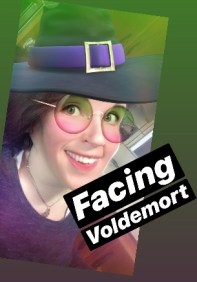
Facing Voldemort

Standard

When you’re disabled, you learn to adapt… tweak… make-do. These skills are essential, because as much as the modern, progressive world likes to think it’s ‘woke as **ck‘ — it’s really not. Full inclusion of disabled people in society is a long way off, and these issues barely register on even the most liberal political agendas. In fact, during this election season’s rounds of televised Democratic debates, I haven’t heard one of the 318 presidential candidates even say the word ‘disability.’ Considering disabled Americans are the largest minority group in the country— one that spans race, gender, religion, sexual orientation, and socioeconomic background— you’d think it would come up. At least once. (Just like Bernie Sanders yells and shakes his fists at another candidate at least once a debate.)

It’s possible the candidates are just being thoughtless in ignoring disability issues in the debates— like when careless people forget to put another roll of toilet paper in the bathroom after they’ve used the last square of Charmin. But, perhaps there is another, more sinister meaning. What if they are subconsciously afraid of saying the word ‘disability‘ aloud because then it acknowledges that we actually exist? And, maybe, just maybe, they are frightened of us? It could be possible. After all, this was why everyone was reluctant to say Voldemort’s name aloud in Harry Potter.

Let’s not forget that even The Ministry of Magic discouraged folks from saying it at Hogwarts. They worried that if someone voiced the name of Voldemort, the most dreaded wizard in the land, it would give him the power and recognition needed to rise up. And that was definitely not okay… because then all the normal wizards would have to face the fact that they were only one Death-Eater attack away from a nursing home run by Hufflepuffs.

So, yeah, you can see why they’d prefer to pretend like we don’t exist. It’s scary to imagine the power potentially wielded by 1 in 5 Disabled Americans. Because not even the mighty Teamsters Union can muster these kinds of numbers— even though Joe Biden desperately wishes that they could.

I think maybe it’s time for us to be a little scary. Be a little loud. Because we are not only fighting for ourselves. We are fighting for everyone. After all, we are also the only minority group that anyone can become member— at any time. Plus, if you live long enough, you’re probably eventually going to need the homecare services we are fighting so hard for, too.

I hate to break it to you, but not even the best Patronus charm can do a damned thing about that fact. Eventually, you’re going to need someone to help you get out of bed in the morning. You’re going to need someone to help you prepare your meals. Hell, you’re probably going to need help wiping your own ass. But, here’s the thing: unless you meet the impossibly stringent & poverty-driven Medicaid guidelines, you won’t qualify for homecare services.

Despite what you may believe, Medicare and private medical insurances currently do not cover homecare. So, you could lose your house, your retirement and all the things you worked your entire life to achieve just to pay for medically-necessary care costs.

Thinking of just going to a nursing home? Good luck with that— the care received in institutionalized settings are substandard, dangerous, and far, far more expensive than the costs of providing care in your own home… in your own community.

Given that homecare is cheaper and safer than institutionalized care, isn’t it surprising that it’s not covered by Medicare and private insurances? Wouldn’t logic say that it should be covered? Well, yes. But, denial is a powerful thing. And the denial of the notion— the reality— that anyone could become disabled at any time in their life is even more powerful. It’s no wonder no one wanted to say Voldemort’s name in Harry Potter. That was some scary shit, yes?

But, if these services existed— and were more available— maybe disability (and even old age!) wouldn’t be so fucking scary to everyone. Maybe then we could change the whole narrative around it.

However, first, a narrative must begin. And, to do that, someone needs to talk about it. But, I’m afraid that with the current slate of presidential candidates, that’s not likely to happen. Why?

Well, the top contenders Joe Biden, Elizabeth Warren, Bernie Sanders and—yes, Donald Trump— are all over the age of 70. Given society’s subconscious aversion to disability and old age, these four main contenders definitely do not want to draw attention to how old they actually are. (I mean, no one wants to yell Voldemort in a crowded cafeteria, do they?)

Even though you’d think these presidential contenders would be ideally suited to discuss these issues (given they are closer to the age of needing these services), there’s NO damn way they are going talk about that. Just look how long it took Bernie Sanders’ campaign to acknowledge his recent heart attack? Look how evasive Donald Trump is in releasing his full medical records? (And, no, it’s definitely not because he’s got the most greatest health in the history of all American presidents— including, of course, all the leaders of the most bigly and powerful nations in Earth history.)

So, who is going to do the talking, if not us? Who is going to make people uncomfortable so that they can face the reality of their own human frailty? That they will need help someday? I guess that falls to us disabled folks.

This election season, perhaps you should give this some thought. Who will best fight for you when you need it most?

Because, like it or not, Voldemort is coming.
witch

Birthday Evolution

Standard

When I was young, I hated the attention I received on my birthday. I hated when people would sing me the “birthday song.” I would whimper. I would cry. And, if my weak SMA muscles would have allowed it, I would have slithered into a ball under a table at the first note of the famous tune.

Many people that know me now would be surprised by this. But, it’s very true. If, on my birthday, I could have burrowed into a hole in the ground like El Chapo evading the Federales, I would have done it.

Por supuesto.

Being a small kid with a visible disability, you always get looked at differently. Always. Even as a tiny child, you sense the eyes that follow your every move. The assessing. The wondering.

The what is wrong with that little girl? gaze that becomes so familiar. While it’s not a scary experience, it is an annoying one.

If you’re wondering what that look is actually like, here’s how I would describe it. You know those ASPCA commercials with that mournful Sarah MacLachlan song? The ones with her singing “Angel” as they show a montage of sick and undersized puppies that will die if you don’t donate $15 a month? You know that sad (nearly tearful) look that your face gets when you see that commercial?

That’s the face I’m talking about.

So, yeah… pull it together, dude.

Anyway… when you’re already ‘different’… and used to being recognized by many as ‘different,’ you don’t want any more attention than absolutely necessary. So, your birthday is yet another extra spotlight that shines upon you each October.

I felt this way for many years. I didn’t want the additional fuss, or the attention, that came with that day. I had enough of it already.

But, as I approached my 30th birthday, a birthday that many doctors had predicted that I may never reach, I began to feel very differently about it. It evolved in my mind. It felt like a milestone. An achievement. A mark of a battle that I was winning.

And, suddenly, celebrating my birthday became something that I wanted to do. It was something that I didn’t want to tuck into a drawer and pretend didn’t exist. I wouldn’t be like Rudolph Giuliani ignoring a Congressional subpoena.

I would face it. And enjoy it.

So, now, here I am, years later, on my birthday, proud to be alive and proud to be a part of this world. It’s been a lot of hard work getting here (and I’ve had a lot of help along the way)— but, I did it.

Happy Birthday to me.

birthday

(Yes, that’s a pumpkin spice latte. Duh.)

Becoming Oliver Twist

Standard

Life with a complex disability, like SMA, is obviously challenging. It takes a great deal of physical, emotional— but, most importantly, logistical— strength to power through each day. Your brain always has to be 2 or 3 steps ahead in order to anticipate challenges that life, and this very inaccessible world, love to throw at you. It’s exhausting. It’s like playing an endless game of Whack-A-Mole at Chuck E. Cheese. You know those little heads are going to pop up somewhere. So, all you can do is keep slamming the mallet down on the board hoping you earn enough tickets to buy a Slinky at the counter.

This constant state of preparedness is a necessary evil. It’s the thing that makes it possible for me to get out of bed in the morning. To have the ability to do the work I do, and I accomplish what I need to accomplish— all while balancing my complex medical needs.

As I’ve discussed frequently before, my custom power wheelchair is a big part of this effort. It’s the most important tool in my life. It’s the object that makes my life— my independence— possible. At the beginning of this year, I began the arduous process of getting a new wheelchair. Medicare requires that many steps be completed before an order can even be processed. Initial Visit With Doctor. Evaluation from Special Physical Therapist. Consult with Wheelchair Provider. Assessment With Doctor.

Each of these steps must be done in a certain order, the documents must be signed and authorized by all parties, and all of it must be done sequentially. Like a really complicated, and really French, pastry recipe. The foofy, pretentious kind. The kind that takes hours to make, you eat in two bites, and leave you hungry afterward.

It’s a fucking nightmare, frankly.

I have a Type A personality. I like to get shit done. This trait has come in handy with my SMA, because such attention-to-detail is why I’m still alive and thriving 35 years after most doctors thought I would be dead.

But, this ‘wheelchair vortex of hell’ doesn’t always reward such preparedness. Because, no matter how on top of things I am, I am still at the mercy of a large medical bureaucracy. The bureaucracy lets unsigned forms sit on desks. The bureaucracy will deny a claim because one date is mistyped on one form. The bureaucracy won’t pick their own nose without a memo telling them which finger to use.

Just a few weeks ago, (but, nearly nine months into the entire process!), Medicare finally authorized my request for my new wheelchair. This was after several paperwork kinks and delays that nearly made me sit in a corner and cry. But, with this authorization, the DME (durable medical equipment) company was then able to place the order with the manufacturers.

You’d think I’d be ecstatic. You’d think I’d be over-the-moon with happiness… you know, just like R. Kelly is in a room of underage girls.

But, I decidedly was not. For I knew that my current wheelchair had to survive until the new chair arrived— which could still take months. And that was the biggest gamble of all.

Because, you see, Medicare would not authorize repairs to an existing wheelchair while a new wheelchair is being ordered. So, I would be majorly SOL if my current wheelchair took a crap in the meantime. Therefore, each bureaucratic delay— each kink that I had experienced in the process— increased the probability of this happening.

And, yesterday, the laws of probability— the laws of mathematics— finally caught up with me. A “RIGHT MOTOR FAULT” error message brought my wheelchair to a halt.

This isn’t the first time this has happened during my wheelchair-using life. In fact, with this wheelchair, alone, I have had to have the motors changed FOUR TIMES. Yes, that’s right. So, when I saw this “RIGHT MOTOR FAULT” error message, I instantly knew that in about a week, my life was seriously going to go down the toilet until I could get new motors installed.

With the arrival of my new wheelchair nowhere in sight, and the necessity of having a functioning wheelchair, I had to do a painful thing. I asked the DME company to order me a new set of motors. I agreed to pay the hefty price. Because, this wheelchair is my basic tool of life, and without it, I can’t function. The DME company understands my pain and kindly agreed to give me a cut rate, but it’s still more money than most people pay for their first shitty car.

To be honest, I actually cried. I sat and cried because I was going to have to find a thousand dollars to fix a device that allows me to live.

It’s demoralizing. And it makes me feel very, very small. In an inaccessible world that’s already stacked against me— a world where I have to be smarter, wittier, and more prepared than everyone else— I still have to scramble for this most basic thing.

But, I don’t have a choice. So, I applied, and received, a disability grant from NMD United to help me pay for some of my replacement motors— and I set up a GoFundMe to cover the remainder of the cost.

The sad thing is, I shouldn’t have to do any of these things. This wheelchair is a medical device. It’s a lifesaving device. I have Medicare. I have a private supplemental insurance plan, too.

I shouldn’t have to peddle to others for something like this. No one with a disability should have to do this— yet, we are forced to do it everyday, in some form or another. It’s so Dickensian. So two-hundred-years-ago.

Yet, nonetheless, here I am, like little Oliver Twist, holding out my small pail—

Please, Sir, I want some more.

oliver

Note: If you are disabled, and have experienced similar problems getting coverage for your specialized wheelchair repairs, please write in & share your story. We must try to speak out when we can. And speak loud. Wheelchairs are more than “durable medical equipment” — they are life-saving and sustaining.

Yes, We’re 20 Years Older Now

Standard

The brain has the amazing ability to compartmentalize time in a way that can make us forget how much time has actually passed. For example, when I’m watching Netflix, my brain will ignore the fact that I’ve watched 3 hours of Grace & Frankie. My brain will swim in this blissful interlude until something cracks it— like the window that pops up on the Netflix app. You know the one I’m talking about. The Netflix window that asks if you are “still there” because so much time has passed since you began watching that it thinks you might be dead.

Personally, I hate this Netflix feature. My brain doesn’t want a reminder of how long I’ve been watching TV. I don’t want someone judging my life choices like that. After all, if I really wanted someone to judge me, the best way to do that is to give birth to a baby. Because then you can watch the entire world criticize every choice you make as a mother for the next 18 years.

Anyway, in addition to compartmentalizing time, the brain is also really good at making us forget how old we actually are. Recently, my high school class celebrated our 20th reunion at the amazing event venue, The Century, owned by our classmate, Erin. Once arriving at the reunion, the glamour of the surroundings was a blast of reality. While my brain understood that 20 years had passed, it hadn’t really understood that we were 20 years older until that very moment. The twinkling lights, the crisp table linens, and the fancy cheeseball shaped into the numbers ‘1999’ were glaringly grown-up. I suddenly realized we weren’t people that had a slice of pepperoni and a soda from Pizza Plus for lunch anymore. We were going to have caprese skewers with aged balsamic. We were going to eat an adult dinner using adult dishes at adult tables.

On the cocktail menu, I saw Gin Rickey. My newly-awakened brain recognized Gin as a very grown-up thing to drink. So, I ordered one. And then I proceeded to put a 14-inch red straw that I stole from a movie theatre into the drink (yes, I may be Adult Elizabette, but some things will never change). My cripply SMA ass will always need to use a straw in a drink. Even though my hands are a little stronger now with Spinraza, they will never be strong enough to lift a cocktail in fancy glassware handcrafted by some dude in Germany.

Another signal to my brain that time had passed? Suddenly most of the guys in my class weren’t recognizable. They were taller. They had facial hair. They had wives that made them wear pants that actually fit. It was very jarring.

My friends and I began to not-so-secretly flip through pages of the yearbooks on display like we were identifying suspects in a criminal lineup:

“Who is that guy over by the balsamic caprese skewers?”

“I don’t know.”

“His chin is bigger than the one in this picture.”

“Yeah— I don’t think he’s our man.”

But, it was when a big-smiled guy approached me with a hearty, “ELIZABETTE!” and a hug that I realized that I had an extra disadvantage in this game of high-school reunion Guess Who. I couldn’t recognize the guy hugging me. He looked nothing like anyone in my class. His chin wasn’t familiar. His pants were appropriately-sized.

But, he clearly knew me.

While being me has many perks (see HERE), one thing is very lacking— anonymity. It’s super obvious who I am. I was the only person in a wheelchair in my entire high school. In fact, I was the first person with a significant physical disability to graduate from Patterson High. So, I could literally have had a Caitlyn Jenner-style transition and they would still pick me out of the crowd.

It’s important to note that this lack of anonymity also makes it impossible for me to commit a serious crime. Don’t believe me? Imagine this:

Police Detective: “So, do you have any idea who may have committed this robbery?

Bank Teller: “Well, she was wearing a mask… but she was driving a fancy black electric wheelchair.

Police Detective: “And you say she was armed?

Bank Teller: “Yeah, but her hands were too weak to even point the gun at me. I felt kinda bad, so I gave her the money anyway.

This lack of anonymity did nothing to help me in this moment at my reunion, however. I was losing this round of Guess Who. As he pulled back from his hug, he said, “It’s me— Gilbert!”

“No-you-are-not!” This slipped out before I could help myself. Like when I cuss in front of small children or loudly burp after I eat cucumbers. It’s just not my fault when things like that happen.

My brain was not reconciling the evidence presented. This was Adult Gilbert twenty years in the future. Not little teenage Gilbert. It was as if, once again, my brain was desperately trying not to acknowledge how long I had been watching Netflix. It wanted to ignore the little pop-up window on the app insinuating that only a dead person would be watching TV for this long.

A little later that evening as I began eating my fancy dinner of chicken in a mushroom cream sauce, I started to think that the being-20-years-older-thing has its perks, too. We are more mature. Our clothing choices are better. And, the food is definitely more sophisticated than back in 1999. And, while it could have been the gin fueling those thoughts (which is possible), I still suddenly couldn’t wait to see what the next reunion would bring.

And at least there’s one thing for certain: I still won’t have to worry about not being recognized…

38E31445-09A9-46BF-9F2C-F6418416A215[7029]

84 Minutes… and Counting

Standard

I recently got a letter from the Social Security Administration asking me to participate in the National Beneficiary Survey (NBS) for those on Social Security Disability. The supposed goal of the survey is to improve programs that Social Security offers and to see how existing services are being utilized. I was “randomly selected” to participate in the anonymous survey. I think this is meant to make me feel special. As if I’ve won some kind of prize— like a free donut.

According to the letter, the policy research company tasked with facilitating the NBS offers a $30 gift card to participants who complete the phone survey. This line caught my attention because I like gift cards. And the fact they were going to give me a gift card for giving my opinion was very enticing. I am a person with many opinions. Further, giving suggestions and feedback is one of my favorite things to do— even when my opinion isn’t wanted, needed, or welcome. So, the fact that they wanted me to give my opinion made this a Win/Win situation for me.

So, I gave them a call. After waiting on hold for a few minutes, I was informed that the survey would take around 50 minutes. That’s a lot of time. And it’s especially a lot of time when you’re a disabled person like me that takes nearly 2 hours to get up, showered, and dressed each morning. But, I did have opinions to share. Lots of them.

I told Lucy, the survey company employee, to proceed. She began by asking me about my disabling condition, which then resulted in me having to spell out Spinal Muscular Atrophy because no one knows what the hell it is. Then, she asked:

“When did you first get a disability that inhibited your ability to work?”

“During the Reagan Administration.”

“Pardon?”

“I mean, I suppose it wasn’t Ronald Reagan’s fault, directly, but I born and diagnosed with SMA while he was president.”

As the questions proceeded, it was very clear that the survey wasn’t written with people like me in mind. This is odd because I’m über-disabled. If you had to give an alien from outer space a stereotypical example of a disabled person, I’d be your girl. But, this doesn’t mean that Social Security sees it that way.

“When do you believe that your disability will improve enough for you to get off of SSDI?”

“Not even the Vatican can make something like that happen.”

“How about in 2 years?”

I launched into a detailed genetic description of SMA, not fully satisfied until I could hear her nails clicking speedily on the computer keyboard in the background. I was determined to make my survey answers the most thorough and detailed she had ever encountered– like damn Tolstoy’s epic War and Peace. I wanted every word I said entered in the record. I was going to earn that $30 gift card.

“What could we do to help you return to work full-time? Job training?”

“I don’t need job training. I have a university degree. I graduated with honors. The main problem here is that Medicare & Social Security Disability Insurance need to cover home-based personal care attendants. The barrier of inadequate home-based care is what prevents many of us with the skills and abilities to work from doing so. How can we work if we don’t have someone to help us get dressed? How can we work if we don’t have someone reliable to drive us there? The faulty poverty-driven Medicaid system inhibits us from bettering ourselves by punishing us for even small advances we make by stripping away the meager benefits we receive. This needs to change. You want more disabled people to work? Make home-care coverage part of the Medicare program. I guarantee you’ll see results from that investment.”

“So, would a job coach help you return to work?”

I began to feel a headache nag at the corner of my temple. I began to seriously regret doing this survey. Just like a woman always regrets getting bangs. While at the salon you think it’s great, you’ll inevitably realize that those bangs will never resemble the rest of the hair on your head. This survey was turning out just like that.

Then, Lucy began asking me about my physical abilities and other aspects of my life. And that’s when the survey became more interesting.

“Can you climb a flight of stairs?”

“I assume you mean without Inspector Gadget’s help.”


“Can you stand and bear weight?”

“Nope.”

“When was the last time you could stand and bear weight?”

“Please don’t make me bring up Ronald Reagan again.”


“Have you served in the Military?”

“HAHAHA! Wait— is that a serious question??”


“Have you participated in the Ticket to Work Program?”

“No. But, I want to talk about the military thing some more.”

“Umm— okay.”

“Can you imagine if I went into a military recruiter’s office and tried to enlist? They would freak the hell out.”

*The sound of Lucy’s typing ceases and she begins chuckling.*

“I should do it. I’m really good at driving my power wheelchair— which is operated by joystick. Therefore, I could pilot a military drone airplane without a problem. So, that means that I could kill innocent civilians just as easily as an able-bodied person… maybe better.”

I glanced at the clock. I had been on the phone for 84 minutes—and counting. The questions went on for a few moments longer, but my attention started to fade until the very last question:

“Is there anything else you’d like to add?”

“Yes, actually. And I want you to write this down. Are you writing this down?”

“Yes.”

“There’s a bill in Congress right now that could address some of the issues I’ve raised in this interview. It’s called the Disability Integration Act. H.R. 555. Those of us with disabilities want to live productive and independent lives. Please help us make that happen.”

She thanked me for participating in the interview, and wished me all the best. Then, she asked me if I wanted the $30 gift card mailed to me, or someone else. Someone else?? I actually had to have her repeat the question because it was so insane.

Does anyone spend 84 minutes on a survey and then give the only good part about the entire experience away to someone else? No. Definitely not. I may be disabled, but I’m not a communist.

Ronald Reagan would be so pleased.

0E015560-BE7F-4F08-A8FF-380198051334[6611]


Lizard Brains & Toffee Nut Lattes

Standard

I’m nearly two years into my Spinraza journey, so you’d think I’d be relaxed about the entire process. That I would have a ‘been-there-done-that’ attitude about the spinal injections, and the subsequent physical and respiratory evaluations that follow. That I’d be that chill kid that doesn’t get emotionally twisted into knots at the sight of the familiar 500g weight… or the large plastic mouthpiece that gets shoved under their lips to test their pulmonary capacities. That my vast experience would allow me to stay cool under these pressures. You know, like Robert Mueller when faced with a nation that can’t seem to read a 448 page document that they forced him to write in the first place?

But, no, I’m decidedly not that unshakable.

I had my 9th Spinraza injection several weeks ago, after recovering from a nasty bout of influenza. This illness took its toll, and I was worried about the effect it could have on the physical and respiratory assessment results to follow. So, in the days leading up to my assessment, I began to physically and emotionally prepare for the grueling day of tests. I doubled-up on my physical therapy. I increased my protein intake. And, most importantly, I talked to my counselor about breathing exercises to try to keep me from slipping into ‘lizard brain’ during the stressful moments of the day.

If you aren’t familiar with ‘lizard brain,’ please know that I’m not making this concept up. It’s not about a colony of salamanders on Animal Planet. Rather, the term refers to a frenzied state of mind that can occur when extreme stress causes all reasonable thought to vanish— and you are left with the instinctual urge to fight, or run away. This part of our brains is very elemental. Prehistoric. And it traces back into the beginnings of life. The ‘lizard brain’ hibernates inside all of us— but, if you are Donald Trump, it’s activated 87% of the time.

I am a naturally competitive person. As I’ve discussed on this blog, I often push myself to my limit. I want the A on the test. I want the gold star. I want to be able to say that I tried my damned best. When my ‘lizard brain’ is activated, my instinct is to fight. Generally speaking, this drive is a good thing. On these physical and respiratory assessments, it means that I give a lot of effort. If my brain calculates that there’s a 51% chance that I can lift that 500g weight, I have a hard time letting that task go. I want those points. I want to see them write it down on their damn little clipboard. My lizard brain can go from ‘off’ to ‘on’ in that exact moment. And it won’t back down until I’m red-faced, shaking— forcing the physical therapist to pry the 500g weight from my sweaty fingertips.

This isn’t necessarily a good thing. A reasonable, normal brain would realize that I shouldn’t waste energy that I will need for the rest of the assessment. But, ‘lizard brain’ makes unwise decisions. It does stuff that’s just not rational. This is why someone needs to remove the Twitter app from the president’s phone.

At Stanford this week, I really tried to keep that part of my brain contained. I came into evaluation day prepared. I was going to be focused. Methodical. I was energized— and ready. The lizard was going to be On. A. Leash.

I ate a good breakfast. My friend, Edith, brought me a Toffee Nut Latte from Starbucks to sip on the drive over to Stanford. It was a size grande. This is an important detail because I generally only order a size tall at Starbucks because my naturally high-strung personality can only handle so many shots of espresso. (This fact will become important as this story moves forward).

About halfway to Stanford Neuroscience, I got the sudden urge to listen to rap music. I never, ever listen to rap music because my taste in music tends to be more similar to a 92-year-old Jewish man than the Millennial hipster that I actually am. But, it felt like I needed to hear that music in that moment. As I started belting out the lyrics to Petey Pablo’s Freek-A-Leek, Edith grew concerned:

“How much of that latte have you drank?”

“Uhm, only like a third of it so far. But, I feel really good about how this day is going to go.”

The music continued. As we approached the bridge into Palo Alto, I started counting overpriced Tesla cars that I’d see on the freeway. They were easy to spot with the pretentious ‘T’ on their trunk. I briefly pondered if the company’s founder Elon Musk liked rap music. Then, I remembered that I needed to worry about my lizard brain, so I did a few breathing exercises and counted fourteen more Teslas. Then, I felt a hot flush run through me:

“Ooo, can you open the window? I want to feel the bay’s cool air on my face on the bridge.”

“Did you finish your drink?”

“Nope. Only half so far. But, it’s really yummy. The Toffee Nut Latte is almost as good as the Chestnut Praline Latte. You know, it’s probably not as good because instead of two nuts in it, it only has one nut. Like Lance Armstrong.”

We parked in the garage, and as the cool air hit my skin, I realized that, for some reason, I was already sweating.

“Fuck, I’m sweating.”

“I should have got you a decaf.”

“Look, my undershirt is stuck to me.”

After checking in to the reception area and drinking some water to hydrate, I waved at my doctor’s nurse practitioner across the foyer. When she came over and hugged me hello, I hoped she couldn’t smell my sweaty and toffee-nutted body.

I was taken back into the exam room and my vitals were taken. When my blood pressure was within the normal range, I was shocked. Seriously surprised. So, my lizard brain decided that it was a good idea for me to drink the rest of my latte.

The respiratory therapist came in a did a full pulmonary function test. Right away, I could tell that all my hard work during my influenza recovery, and afterward, was paying off. The Spinraza was doing its job. The numbers with each respiratory test were coming in higher than before. I was on a respiratory and caffeine high. My lizard brain was secretly tweeting:

“This is the most huge thing ever. I’m the best pulmonary test-taker in history.”

After I caught my breath from those tests, I finished my latte. As my straw was slurping the last toffee bits on the bottom of the cup, the physical therapist came in for the physical assessment tests. With the caffeine pumping in my blood, I felt especially focused. All the world fell away until it was just me and that test. I watched her hand making notations on her clipboard. I started to mentally tabulate points like a card-counter at a blackjack table in Vegas. I was going to bust the dealer. She was the dealer. I would not be stupid enough to take the bust card.

“If I lift this cup this way, will I get more points?”

“No.”

Five minutes later.

“I know I only get three tries to do the task successfully and get my points. But, if I don’t set the item down, it still counts as one try, right?”

I don’t know if the caffeine was doing it, or all the preparation I had done, but I felt a zing of excitement as, one by one, the tasks came easier than I had expected. My mental tally was telling me that my score was higher than last assessment. And the therapist agreed:

“You’re doing really well. I think you’re ready to try an additional task we haven’t done before: putting you on the end of a table to see if you can sit upright all on your own. Without any support.”

“Will I get more points for that?”

“Yes.”

“Then let’s do it!”

I’d like to report that I did get those points. I did sit on the edge of that table all on my own. First, I did it bracing on my own hands. Then, I did it without the support of my hands for even more extra bonus points. It was an amazing moment. Edith even cried a little because it’s a task we’d never thought I’d be able to do.

I’d like to say that this achievement was emotional for me in that moment, too. That this milestone was the culmination of two years of treatment that paid off in a tearful crescendo.

But, it didn’t happen in that way. And you know why it didn’t? Because my lizard brain was too busy shouting:

“GIVE ME ALL THE POINTS!”

It was still all worth it, though.

A3E2851F-3C45-4806-93E8-0ED55A87C35E[6454]

Red Tape, Duct Tape & The Wheelchair Vortex

Standard

When you’ve got a rare and complex disability like Spinal Muscular Atrophy, time can be a very precious commodity— like diamonds, Labradoodle puppies, or a really good Wi-Fi signal. Since many everyday tasks can take us longer to complete (like showering, eating, and getting dressed), we tend to budget the rest of our time wisely and carefully. It’s an important skill to cultivate when you have a disability— otherwise you’d never get that term paper done, never balance your checkbook, and never have time to buy laundry detergent at the store.

Along with these everyday tasks, life with a complex disability comes with a lot of hidden bureaucratic demands that take up time. Between filling out on-going forms for Social Security and state services, to coordinating between various caregivers, doctors and therapists, to following up on medications and equipment, it’s a vortex of bureaucracy that keeps our lives in motion.

The time it can take to attend to this red tape is daunting. You know the hours it can take to prep and cook an entire Thanksgiving dinner? That’s a LOT of time, right? Imagine having to do that several times a month— even when you’re tired, sick, or just want to lay in bed and watch people get decapitated on Game of Thrones. That’s what it is often like for us. Plus, we don’t even get any leftover turkey out of the deal (which is totally lame because I love leftovers!).

Recently, I’ve had an extra bundle of fun (can you sense my sarcasm?) added to my usual list of bureaucracy. This task is at the top of my list of The Most Dreaded Of All Tasks. In fact, I daresay it is the veritable Mount Everest of tasks a cripple like me must climb. And I don’t say this lightly because I literally can’t climb anything at all.

It’s the Trying-To-Get-A-New-Power-Wheelchair-Vortex-Of-Hell.

Sure, it might sound exciting to get a new custom power wheelchair— to get a bright shiny new model with fancy features and leather upholstery that smells like a pretentious Italian shoe. But, a new wheelchair ain’t a Prius (even though it can cost nearly as much). They are also not so interchangeable as to be simply a matter of budget, taste and style.

As I’ve written on this blog before, these wheelchairs are built to our specific measurements and our medical need. They are designed to maximize independence and health. They are the very tool of life. And, when you have a complex disability like SMA, a small change in a wheelchair design or an error in a measurement for the seating can mean the difference between sitting comfortably to having a pressure sore on your buttocks. It can mean the difference between being able to drink a glass of water independently to not being able to reach the table at all. So, a lot can ride on these devices and making sure they are fit appropriately.

That’s a lot of stress— and a lot to add to our already-busy plate. So, it’s not surprising that we’re often not eager to get a new wheelchair when we’ve still got one that works well. But, as time goes on, it can become difficult to get parts and do repairs. Plus, I can’t speak for every disabled person, but I’d rather not go too long with a decrepit wheelchair that’s only held together by loose wiring, duct tape, and human stubbornness. (I think we’ve got enough of that in the White House).

So, every 7 or 8 years, I begin this process anew. Given the price tags on these custom wheelchairs, insurance companies don’t make it easy to qualify for coverage. There are many hoops that a person must jump through to get a power wheelchair. This is ironic because most of us that need these devices literally can’t jump at all.

First, my doctor must reestablish my need for a power wheelchair and reverify my disability. This is despite the fact that I’ve been this way for 37 years. It’s as if they fear that my genetic condition is going to suddenly disappear into thin air— like Lori Loughlin’s career.

Second, I must be seen by a special neuro physical therapist that will do a head-to-toe functional assessment— which must corroborate my doctor’s findings and include an analysis of whether my mental state is good enough to operate a wheelchair without driving myself off a cliff.

(Even though this process makes that very, very tempting.)

After that, my doctor has to verify the special neuro-physical therapist’s evaluation and that it’s in full agreement with his recommendations. He then sends it all to the DME company, which is in charge of fitting me for the new wheelchair and making sure it’s functional.

I’m fortunate that I have a long and positive relationship with my local DME (durable medical equipment) provider, Alan. He has been very accommodating and helpful to me over the years. He’s put up with my tears of frustration, my harassing phone calls, and my complaints about how ugly all their wheelchair paint color options actually are.

Insurance companies don’t make this process easy for DME providers, either. To be frank, they make it a giant pain in the ass, which has driven many DME companies out of business, which in turn makes it hard for disabled folks like me to get our rickety wheelchairs repaired or replaced.

It’s the red tape nightmare that just keeps on giving— like a bad case of shingles.

Anyway, Alan came over a few days ago and we came up with an initial plan for my new wheelchair. This plan basically consisted of me pleading desperately:

“Alan, make the new chair exactly the same as this chair. Seriously. Like not even a centimeter difference. Okay? You know the old fable, ‘The Princess & The Pea?’ I am the Princess. Trust me, I will know if there’s a pea under the mattress…..Umm, why are you laughing? I’m not kidding. I am the Princess. There will be no PEA in this WHEELCHAIR!

Realizing I sounded slightly deranged, I coughed, and added:

“By the way, would you like a cup of coffee? Perhaps you might need it now.”

And that’s basically how that initial consult went.

It’s now up to Alan and his team to gather all his notes, the paperwork from my doctor, the assessment from physical therapist, and to combine it all together to submit for insurance approval. Every “T” must be crossed, and every “i” must be dotted. If it isn’t, I will have to begin the process again— the idea of which makes me want to cry.

Here’s hoping the duct tape will hold out until then, though.

Wish me luck — And stay tuned for updates!

F7828E79-5F0E-4879-960F-3635AE10F524[6351]

Inclusion & Integration — Everyone Wins

Standard
(This piece originally appeared today in The Patterson Irrigator.)

Recently, this newspaper chronicled the story of Owen Tyler— a seventh grade student with Down syndrome that is an active and valued member of the Creekside Middle School wrestling team. A video from one of his matches went viral online, highlighting the story of his inclusion in school and community activities. When I saw the video myself, it made me smile. After all, where there is inclusion, all humanity thrives and flourishes.

I would like it if we lived in a world where stories like Owen’s became commonplace. That inclusion became the rule, not the exception. That videos like the one from his wrestling match became so ordinary that there would be no need for it to be on television news.

As a disabled adult, I can attest to the importance of inclusion. I spent my youth mainstreamed in school classes and welcomed in extracurricular activities. This allowed me to grow and shaped the adult I would become. Further, I learned that each diverse voice counts, and that includes disabled voices like mine. Like Owen’s.

We must remember that inclusion of disability doesn’t end in childhood— it must continue on into our later years, too. After all, we spend much more of our lives as adults than we do as children. So, as a society, we must commit to this principle. We must value these life experiences and the importance they bring to society at-large.

The disability community is the only community of which anyone (regardless of age, race, gender, and income) can suddenly find themselves a member. An illness, an accident, the effects of age, can all lead someone to become disabled. At any time. This is why valuing inclusion is so important. Because there’s a good chance that it could affect you, or someone you love dearly, at some moment in life.

There is a bipartisan bill sitting in Congress right now called The Disability Integration Act (S.117, H.R. 555). It seeks to secure the Constitutional right to liberty for disabled people and seniors who want inclusive lives in the community. It wants to help aging seniors and the disabled stay in their homes. It seeks to save millions of federal and state dollars by avoiding expensive institutionalization, which is far costlier and less-effective than home- and community-based services. But, most of all, it seeks to make the spirit of inclusion part of the law.

This bill needs public support to help it move forward. So, I urge you to learn more about The Disability Integration Act. Talk to your elected representatives. It could make a big difference to you and the future of your loved ones— whether you realize it now, or not.

After all, where there is inclusion, all humanity thrives and flourishes. Just ask Owen.

IMG_5795[4613]

Further Adventures in Physical Therapy

Standard

A few months ago, I reentered the world of physical therapy after a 20+ year hiatus. Sure, I’ve had the occasional physical therapy assessment during the course of my Spinraza treatments for my Spinal Muscular Atrophy the last couple years. But, nothing on a regular basis since childhood. Over twenty years ago. I know this hiatus was long. Like really long. The kind of hiatus you usually only find in the careers of really famous people. Like Barbra Streisand. Or Betty White. Or, Roseanne Barr before she dumped her career in the toilet again.

I admit, of course, that I brought a lot of emotional baggage with me to my return to physical therapy. I had a lot of painful ghosts in my closet that I didn’t enjoy examining again. (Just as I don’t like remembering all the baggy printed sweatshirts I wore in 1993.) But, I suppose that despite all of that, the important thing is that I returned to physical therapy in the first place. Even if it took a long time. (There’s no forgiving those ugly sweatshirts, though.)

Since the autumn, I’ve been going to sessions with a local PT once a week. Given my eccentric crippliness, I’ve been an academic challenge for my physical therapist, Robbie. Spinal Muscular Atrophy is not a run-of-the-mill knee replacement. Or a case of whiplash. Or a strained shoulder. It’s an all-over-the-body kind of weirdness. It’s like trying to teach music to a kid that can only reach 12 of the 88 keys on the piano. Coming up with a song to play under that kind of limitation takes some skill and imagination. It goes without saying that Mozart definitely won’t be in my repertoire. But, I’d settle for a little… Do Re Mi, maybe?

Luckily, my PT has risen to the occasion. He did some research. He thought outside the box. And, he developed a therapy program that is as eccentric and odd as I am. It features a random assortment of objects and tasks— seemingly like some shit he just grabbed from his junk drawer at home on his way to work. After all, everyone has a drawer like this at home. The kind with paper clips, dried pens, rusty green pennies, and silly putty from 1987.

From the look of my therapy table that first day, though, Robbie’s junk drawer had a different collection of crap. Wooden clothespins. A small cloth Easter basket with a yellow chick on it. A rubber tube that resembles a giant Twizzler. And a travel coffee mug. Junk, nonetheless, but higher-quality junk than I tend to find in my drawer.

Anyway, each session he lines up the clothespins on the edge of the Easter basket and has me pull them off one-by-one. This may sound easy, but I’d like to say for the record that it is not. A surprising number of muscles have to work together to pinch a clothespin, remove it from a rim, and then place it inside a basket. So many tiny muscles that don’t always want to work in unison. It’s hard. I have dreams about these clothespins and that damn Easter basket. The perky baby chick taunts me when I fail. It’s very annoying.

Luckily, the other tasks aren’t so aggravating. We do range-of-motion stretches and exercises to strengthen my torso and neck. Then, we do bicep curls with the giant rubber Twizzler. At the end of the session, I practice lifting the travel coffee mug to my mouth to simulate taking a sip. Robbie puts water in the mug beforehand— but he doesn’t tell me how much so I get challenged by the weight.

Some folks may lift hefty barbells… but, it seems like I can lift an $11 dishwasher-safe container.

The other day, though, my PT had an addition to our session. To work on my neck and torso muscles further, he rigged a red laser pen light on the bill of a baseball cap. He put the cap on my head and then put a bullseye target on the wall. Keeping my posture as straight as possible, I aim the laser onto the target, and work to keep it there as long as I can. It’s way more challenging than you’d think. Imagine a low-tech version of Nintendo’s Duck Hunt. Yet, it’s just as satisfying. Plus, there’s no pixelated dog on the screen to smirk when you lose.

I look forward to seeing what else is in store in the coming weeks. This overall experience has been more fun than I expected at the outset… and not just the moments when I threaten to blind Robbie with the laser. It’s also been challenging, but in a good way… a competitive way. Like when I read War & Peace by Leo Tolstoy a few years ago. It was long and massive, but when I finished it, I was proud of myself. I gave a cry of triumph, “I MAY NOT BE STRONG ENOUGH TO LIFT THIS DAMN BOOK… BUT, I READ IT, ANYWAY. HA!”

If all this wasn’t enough to recommend this experience, though, I’d also like to report that my physical therapist has noticed some subtle improvements as I’ve progressed through the last few months— which is really encouraging. My arms stretch higher. My neck muscles hold longer. And I can lift a whole lot of water in that mug. So, stay tuned for more updates in the coming weeks…

Until then, watch out for my red laser!

IMG_5719[3708]