Not a “Great” year, so far.

Standard

Here’s a list of just some of the policy changes that have impacted my life in the last nine months.

  • The massive $1 trillion in Medicaid cuts passed by Congress: in anticipation of these cuts, states have already begun to restrict eligibility for services. Just recently, I had to surrender my financial autonomy & independence just to keep the vital caregiving assistance that allows me to go to the bathroom, take a shower, and do all my daily tasks. As the Medicaid cuts take further effect, I anticipate my caregiving hours will be reduced, and I will have less care and support.
  • I had been scheduled to begin two new groundbreaking treatments for my Spinal Muscular Atrophy in December. These treatments had been in the works for years and the data shows great results. Last week, the federal government delayed the approval and shocked our entire community of doctors, researchers and SMA families. No word on when/if I will be able begin these treatments. (I suspect, given the funding cuts to Medicaid and healthcare, the government doesn’t want to pay for these treatments and decided to kick the can down the road.)
  • The federal government cancelled Rare Disease Day in DC. This worldwide, annual event promotes awareness, support programs, and clinical research into rare disabilities, like mine.
  • This week, the federal government revoked the policies that force airlines to protect disabled passengers in wheelchairs. Corporate airlines lobbied this administration to slash these protections to save themselves money and effort. It worked. It will now be more dangerous for disabled people, like me, to travel. This is a reversal of hard-fought disability rights.
  • For “budgetary” reasons, many states are fighting to erode the federal protections of Section 504 for disabled adults & children in schools. This is an assault on the progress we’ve made to improve disability inclusion. The dismantling of the Department of Education (which enforces these policies) will make this worse.

I’m sad and tired of these systemic efforts to slash vital programs, services and policies that help my disability community.

What has our nation become? What’s next?

The Tale of Three Jobs

Standard

When you’ve got a significant disability, like I do, you often have three jobs. This makes sense, right? In 2025 America, no one has only one job anymore. Who do they think we are… Boomers?

So here’s a rundown of my jobs. Please note that none of them are with Uber, DoorDash, or the Department of Government Efficiency.

JOB #1

This is my actual job. The thing I do that makes me money (but not too much money). It’s important to note that the amount of money a disabled person can earn is limited. For me, it’s $967 a month. Yes, I know that’s equivalent to a wage from an 1800’s coal mine. It’s a pittance. Especially in our economy where you need a reverse mortgage to buy eggs. But at least I won’t get black lung at 29 and leave behind 7 children to die in a Dickensian hellhole.

I cannot earn more than the prescribed amount. If I do, the federal government will slap me with a hammer and scream: “WTF! YOU ARE NOT DISABLED! STOP FAKING IT, YOU LIAR!” Then, they will take away the meager disability benefits that I receive. For me, that’s also $967 a month.

In case you were under any delusion, being disabled is not a lucrative enterprise. We’re not rolling in cash. We’re not dropping Benjamins at the club like Diddy in the 90’s. We’re lucky if we’ve got extra cash to buy the name-brand “soft” disposable underwear instead of the cheap store brand. After all, peeing your pants in comfort is a luxury for people who aren’t disabled.

JOB #2

This is the administrative/logistical job that a disabled person has to undertake that allows us to… survive? It’s the minutiae of disabled life. It’s the doctor appointments, wheelchair repairs, medication management. It’s the arduous bureaucratic tasks of dealing with insurances and government benefit requirements. It’s the complications of coordinating homecare. And ALL the other assorted stuff that needs to be done. I’d like to point out that Job #2 is the most time-consuming of all my jobs. If I got paid for all the time I spent on it, I’d have PLENTY of money for the fancy paper underpants. The good shit with the soft pink flowers that hug my thighs like a cloud.

JOB #3

This is the most unexpected job of all. This is the extra labor that disabled people like me must do because OTHER people (often medical professionals) don’t know how to do their jobs. This work is unseen, unrecognized, and sometimes… super weird.

There is a widespread belief that healthcare workers are trained in how to handle/assist disabled patients. That their education includes disability awareness and information. Well, I hate to be the bearer of bad news, but that ain’t true. At all. In fact, the most ridiculous things I’ve EVER heard said aloud have come from one of two places. The mouths of healthcare professionals. And the mouth of the dude that lives at the White House.

I once had the following conversation with a cardiologist at an initial consult. (Note: I did not return to see this guy again.)

Me: “Do you have any disabled patients?

Doctor: “Err, yes… so many. You can trust me. Definitely.

Me: “Okay. So, what are your questions for me?

Doctor: “Where do you sleep?

Me: “In a bed.

Doctor: “What do you eat?

Me: “Food.

Doctor: “How did you get here?

Me: “I flew in on a magic carpet.

I wish I could say this was a joke. Or an isolated incident. But stuff like this happens to me ALL the time. I’ve been asked if I can talk… write… read… and do basic thinking. It’s super fun.

At the same time, though, people like me are silently expected to provide lessons and ongoing encouragement to healthcare workers on how to treat us. All because people aren’t trained (or can’t be bothered to learn on their own) how to do so. Often, we must undertake this extra labor in moments of sickness, exhaustion and vulnerability. Because, if we don’t, we won’t receive the care we need. And that can mean the difference between life and death.

Sometimes, though, our efforts are met with resistance. Sometimes healthcare professionals don’t want to admit to their ignorance. They don’t want to ask for help. And it’s these folks that are my favorite targets.

The other day, I had a cardiac ultrasound as part of a routine checkup. When I arrived, the ultrasound technician took a look at me and I saw fear flash in his eyes. I’m well accustomed to this look. I am a boogeyman that ushers stress, despair, and way more work than an ultrasound technician wants at 1:40pm on a Wednesday afternoon.

But, just as quickly as that look arrived, a confident bravado slid down his face. His chin lifted in defiance. Nonetheless, I pushed onward and automatically began to offer him the information he would need to complete the ultrasound. Specifically, I tried telling him that my organs are squished in my body because Spinal Muscular Atrophy causes scoliosis. But, as I was in the middle of warning him that my heart wouldn’t be in the “usual” spot, he waved off my words with a cocky shrug: “Yeah, yeah, yeah. I got it.

I snapped my mouth closed. Inwardly, I gave a little cheer. In that moment, I knew this appointment would be nearly as much fun as the last episode of South Park.

For the next 20 minutes, I lay smirking in the darkened ultrasound room while the technician looked for my heart in all the wrong places. His frown grew larger and larger with each minute that went by. Eventually, he found my heart. (Duh. I’m not a vampire.)

But any satisfaction the technician may have felt in that moment was erased when I said, “I could have helped you find it, but it seemed like you really wanted to do it on your own. It was probably more fun that way? Like a scavenger hunt?

My philosophy is to take joy in the little things. For me, that’s what life is all about. It’s the small things. The little joys. These moments build a full, happy life. And, in that moment, I knew that ultrasound technician wouldn’t forget me. He wouldn’t forget how I made him feel incompetent. He wouldn’t forget how those extra 20 minutes wasted finding my heart meant that he couldn’t watch porn on his phone between patients.

And that made me happy.

So, I guess Job #3 ain’t all bad, right? Some of the perks are worth the frustrations. Too bad they don’t include high-absorbent cotton blends.

Oh, well. A girl can’t have everything.

Collateral Damage

Standard

What I’m going to write here is very important. I ask for your time, patience and understanding.

The programs that support disabled people like me are in peril. Serious peril. Since I suspect this notion will be met with confusion and denial, let me explain why:

At the end of this year, the 2017 Tax Cuts passed during the first Trump administration are set to expire. This legislation offered large tax breaks, mainly to corporations and the top 1% of Americans. This tax cut was primarily funded by increasing the national debt.

Corporations and super wealthy people have really enjoyed these tax cuts. So, they have been lobbying HARD to get these tax cuts quietly renewed this year before they expire. However, to renew these cuts, they first must figure out how to pay for it.

The price tag to renew these cuts? Around $4 trillion. Yes, you read that right. $4,000,000,000,000. That’s twelve zeros. A zero for every day of Christmas. A zero for every Apostle. A zero for every month of the year. A zero for every bulging vein that has developed on my forehead.

Now, here is where you really need to start paying attention. $4 trillion is a ridiculous amount of money. They know this. But the political/financial pressure being put on this new administration and legislative majority to quietly make this tax cut happen is HUGE. It’s bigger than Elon Musk’s ego. It’s the real reason Elon Musk is even in Washington at all.

The House Budget Committee has already begun identifying targets for budget cuts. It would be reasonable to think that every single government agency, program or department would be on the list. But that’s not the case. The number one target on the list?

Medicaid.

The program that serves the most vulnerable of Americans: the poor, the disabled and the elderly.

Sure, finding “fraud” and “wasted spending” in social programs is the explanation provided for Musk’s involvement. But, in reality, fraud and wasted spending in these departments is nominal. it’s incredibly difficult to qualify for these programs and to remain eligible. Further, efficiency and fraud offices already exist because spending money on poor, disabled and elderly Americans is something that the US Government doesn’t really like to do. We’d much rather give a blank check to defense contractors that donate generously to political campaigns.

Instead, they plan to amputate nearly $1 trillion from Medicaid. That’s a quarter of the amount estimated they need to renew the tax breaks for Mr. Musk and his friends.

A funding hemorrhage of that magnitude would be catastrophic for disabled people, like me. The Medicaid programs that provide home and community-based services, medical care, and supplemental nutrition would be thrown to the wolves. We would have to beg for crumbs and scraps in a world where we carry ZERO political clout.

Did you know that people like me can’t run for elected office even if we wanted to? I’d be putting any government assistance I receive in jeopardy. There are strict rules I must follow to qualify for the Medicaid program that helps me get out of bed in the morning and use the toilet. I could lose everything by just trying to be a legislative voice for my disability community.

That is precisely the reason why Medicaid makes such an easy target: we don’t have representation. We don’t have money to buy a seat at the table. We don’t have a corporate lobby. It makes complete sense that they come after us first. If you don’t believe that (or want to believe that), then you might be in denial about how the world works.

This brings me back to where I began. If you voted/support the new administration, I have a request of you. Do you want people like me to be the collateral damage of that vote? Do you want the legacy of this era in history to be the moment when America failed its most vulnerable?

I believe your vote was made with honorable intention. So, are you now willing to hold your elected representatives to account? Are you willing to remind them of their moral and ethical responsibility?

Your support is needed now more than ever. I know you care. But now is the time for action. Please call the offices of your congressperson, and your Senators. Tell them you support Medicaid and want them to vote to protect it– not cut it. And keep calling on a regular basis. It will only take you a moment to do this. While it may not seem like a simple call could make a difference, it does. They listen to their constituents. You have power. Please use it. It could make all the difference.

I’m counting on you.

Call-to-Action

Standard

Dear Readers & Supporters:

The results of this election will have far-reaching impacts on the programs and services that my disability community relies upon. The heavy tax cuts prioritized by the incoming presidential administration and Congress will come with a price. Something will pay. And, if history serves, the programs that support disabled adults and disabled children are the easiest and most-likely target for these cuts. The most vulnerable always suffer in times like these. Disabled people like me are deeply frightened about what will happen in the coming years. For us, it’s about survival— and living independently in our communities and having access to support services. Others have the privilege to vote on the price of eggs, which candidate is more “Christian,” which candidate allows them to buy 7 guns they don’t need, which candidate they think “loves America more,” or which candidate will protect them from supposed boogeymen that eat cats & dogs. But, we disabled people have to worry about a budget cut that means we only get to go to the bathroom twice a day, instead of three or four times. Or, figuring out what to do when the program that provides the meals that fit our specific nutritional needs is slashed to give a tax cut to those that don’t need it.

Disabled children and disabled adults must not be sacrificed in political storms.

To that end, I have attached a copy of the note that I will be sending to all my elected representatives in the coming days/weeks/months. If you want to be part of this advocacy effort, feel free to borrow from it for your own outreach purposes. Your support is appreciated and needed.


Here is a link to find your specific elected officials: https://www.usa.gov/elected-officials


LETTER SAMPLE

As your constituent, I am writing to affirm your commitment to support and defend the rights and care of disabled Americans. I was born with a severe neuromuscular disability called Spinal Muscular Atrophy. The heavy tax cuts prioritized by the incoming presidential administration and legislatures WILL come with a price. If history serves, the programs that support disabled adults and disabled children are the easiest and most-likely target for these cuts. The most vulnerable always suffer in times like these, but you have a duty to look after our interests. The disability community must not fall victim, as they have in the past, to political whims and selfish agendas that often leave us behind.

I ask that you pledge to safeguard priority funding for Medicare, Medicaid, in-home supportive services, public education, DDS regional centers, and supplemental nutrition programs (including medically-tailored meals). These services are vital to our disability community and we are deeply frightened about what will happen in the coming years. Our lives are in your hands. We have a right to live safely and independently in our communities.

I hope you take these words to heart. We are a large and diverse community of disabled adults, disabled children, loving families, and supportive allies. We are ready to make our voices heard.

Please don’t let us down.

Thank you.

Death by Bureaucracy

Standard

#DisabledLife is filled with unexpected surprises. Sometimes, it’s having a caregiver call out, leaving you scrambling to find someone to come get you out of bed before your bladder explodes. Sometimes it’s getting into your wheelchair, desperate for coffee, only to discover that the motors have died. Mind you, this is just 18 months after you spent $1,000 to replace those same motors. Good luck getting insurance to pay for it… those miserly wankers only dispense wheelchair repair money in tiny allotments— like it’s radioactive uranium. 

#DisabledLife is also all the time you burn navigating the minutia of a society not designed for people like you. Inaccessible places. Healthcare bureaucracy. People that won’t wear masks. But, if that wasn’t enough, #DisabledLife is also spending hours trying to get medical professionals to believe that you know more about your own needs than they do. (Heaven forbid!)

This weekend, I had another one of these #DisabledLife surprises. In my mailbox, there was a packet with one of the most dreaded return marks in the corner:

SOCIAL SECURITY ADMINISTRATION

When I saw it, I knew that nothing fun would be inside. There would be no Target gift cards, or 50% off coupons for pumpkin spice candles. There would be no sweet messages with heart emojis or stickers that smell like root beer. Instantly, I knew that no matter how good my day had been going up to that point, that the rest of my joy (and patience) was going to be drained by the contents of that envelope— like a damn black hole.

“Fuck.”

Yes, I actually said this aloud.

Then, I stared at the envelope for a few moments, debating when/how to open it. I eyed it suspiciously, like a bomb squad specialist defusing an explosive. When I couldn’t take the anxiety anymore, I grabbed my homemade letter opener (with a long handle designed for my weak, skinny hands), and sliced it open.

I read the top of the page:

“The Social Security Administration must regularly review the cases of people getting disability benefits to make sure they are still disabled under our rules. It is time for us to review this case. Enclosed is a Disability Update Report for you to answer to update us about your health and medical conditions, and any recent work activity… Please complete the report, sign it and send it to us in the enclosed envelope within 30 days…”

In case this jargon is confusing, let me translate: Social Security has given me 30 days to prove that my permanent, genetic disability hasn’t magically disappeared… like classified documents do at Mar-a-Lago.

I grumbled. And cussed some more. Then, I changed my weekend plans from “Binge Abbott Elementary on Hulu” to “Fill Out Useless Paperwork.”

My irritation was massive. It took all my willpower not to set the packet on fire. (Truly.) Yet, I managed to complete the forms. For the sake of my own sanity, though, I added the following letter for good measure.

Think they will reply?…

October 8, 2022

SOCIAL SECURITY ADMINISTRATION, P.O. BOX 4550, WILKES BARRE, PA 18767-4550

SENT VIA UNITED STATES MAIL

Dear Person Working At The Social Security Administration:

Hello. First, I’m sorry that you work at Social Security opening mail and reading letters just like this one. Everyday. Even after you’ve been sick with the “flu” — or, as is more likely, just hungover from too many margaritas.

Second, I’d like to introduce myself. My name is Elizabette. I live in California with a cat named Charley that likes to steal my breakfast. I was diagnosed with Spinal Muscular Atrophy, a genetic neuromuscular disability, at the University of California, San Francisco, just before my 2nd birthday. I started using a wheelchair at the age of four, when most kids are just learning how to pick their nose. My disability is progressive, so I transitioned to a power wheelchair at the age of seven.

Third, I’d like to assure everyone at the Social Security Administration that, yes, I’m still disabled. My genetic disability can’t be cured by clicking my heels together three times. In fact, I couldn’t even click my heels together if you asked me. Because, yes, I’m THAT disabled.

I need help with all my daily needs— like getting out of bed, showering, getting into my wheelchair, and cooking meth in my kitchen.

Anyway, here are a few more facts that might help you determine my disabledness. (Yes, I just made up that word. Feel free to use it, if you want.)

— I’m unable to drive, so I must hitchhike everywhere like a 1970s hippie just before they were murdered by the Zodiac Killer.

(Just kidding. Folks drive me around in an adapted minivan. You know, the kind of car that hauls around eight-year-olds and smells of stale Happy Meals.)

— I’m a patient of the Stanford Neuromuscular Clinic. I am followed by their team of neurologists, pulmonologists, physical therapists, respiratory therapists, nutritionists, butchers, bakers, and candlestick makers. My last checkup was on March 15, 2022. My next checkup is just a few days away.

— I’m attaching a copy of my health record from Stanford, just in case you don’t believe how damned disabled I actually am.

— I work from home a few hours a week as a bookkeeper. This part-time job gives me the flexibility to rest when necessary, and to tailor my work-schedule to my physical and medical needs. I can’t work a full-time job, or work away from home.

— My job pays me $600 a month. You folks at Social Security only give me $596 a month because you think I live in an alternative timeline where everything costs the same as it did in 1958. I use all my money to pay my caregivers. Every. Single. Dime. And it’s NOWHERE near enough to cover the total cost. This is why I sell my body on Craigslist.

— My lung capacity is 42%. Given my respiratory weakness, I am at-risk of severe complications from most illnesses. So, I avoid crowded, public spaces. This is a bummer, yes. But as most people kinda suck, I actually don’t miss this as much as you’d think.

— Oh, and I am unable to wipe my own butt. So someone else has to do it for me. Further, I poop twice a day. I know you didn’t ask this on the form. But, as Social Security seems to want to verify EVERYTHING about me, you might as well know this, too, right?

I guess that’s it for now. Let me know if you need me to provide anything else— like my firstborn child.

Most sincerely,

Elizabette

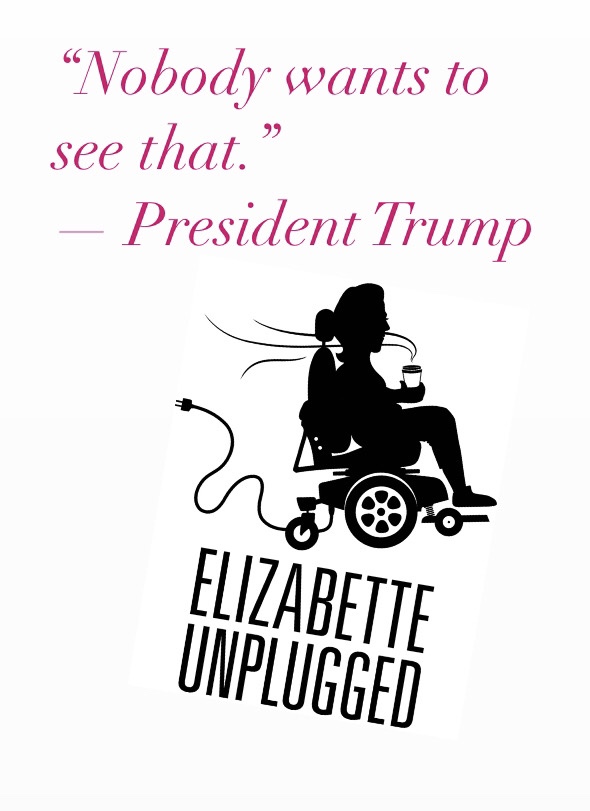
“Nobody wants to see that.”

Standard

In my writing, I haven’t shied away from making a joke or taking a snarky jab at people in power. I can’t help myself from doing it. It’s a compulsion. Like cussing and eating too many pumpkin-flavored products. As you might know, President Trump has been a recipient of this on multiple occasions. It’s just soooo easy when the man rabidly tweets nonsense at 3am, has a squirrel nest living on his head, and can’t address someone without adding a schoolyard insult in front of their name like he’s Biff from Back to the Future.

Yesterday, The Atlantic published an investigative report (the content of which has since been independently corroborated by The Associated Press, The Washington Post, and Jennifer Griffin of FoxNews), that the president has repeatedly disparaged military service members, calling those who died “losers” and “suckers” and that wounded and disabled veterans should be kept out of military parades. This article, and its contents, are currently being dissected all across the Internet, the Twitterverse, Middle Earth and Narnia— so, there is no need for me to delve into the article, as a whole. That’s being done by many others.

However, having said that, there is something in the piece that I do want to highlight. Something that I haven’t seen properly examined. Something, that as a disabled person, I read with deep sorrow, and, yet, it didn’t come as a surprise in the least.

The editor in chief, Jeffrey Goldberg wrote:

“‘He has a lot of fear,’ one officer with firsthand knowledge of Trump’s views said… Several observers told me [Goldberg] that Trump is deeply anxious about dying or being disfigured, and this worry manifests itself as disgust for those who have suffered… Trump has been, for the duration of his presidency, fixated on staging military parades, but only of a certain sort. In a 2018 White House planning meeting for such an event, Trump asked his staff not to include wounded veterans, on grounds that spectators would feel uncomfortable in the presence of amputees. ‘Nobody wants to see that,’ he said.”

Many have attacked this article as being unbelievable. A hit job. And “fake news.” That the president would never say such things. But, as a disabled person that has lived in the United States of America since my birth, I can say without hesitation, that the message and the view that I quoted above is utterly believable.

For centuries, the disabled were hidden away from view, believed to be curses from God, and were not allowed to live full, meaningful and proud lives. The ultimate evidence of human frailty and mortality, the disabled were to be shamed, pitied, and in some cases, exterminated. For disabled people of color, this marginalization is even more profound and insidious. Something we, the disabled, are definitely not? The mascots of strong, advanced, and powerful civilizations. (Just ask Russia. In 1980, they said that disabled people didn’t exist there at all.)

Some think these attitudes are a thing of the past, that we’ve come far as a society. After all, a few buildings now have ramps and crippled folks have designated parking spots to use— but, truthfully, these are often filled by privileged wankers who park there “For-just-five-minutes-while-I-drop-off-this-package-of-LuLaRoe-yoga-pants-at-UPS-to-ship-to-my-cousin-DeeDee-while-I-keep-my-motor-running-so-you-believe-that-I’m-not-breaking-the-law.

But, deep-seeded notions, including those about disability, don’t disappear overnight. They persist. It’s why FDR knew he had to hide his disability to be President of the United States. There’s no way this country would elect a man in a wheelchair to be Commander-in-Chief. No way.

It’s probably also why Chadwick Boseman sadly hid his medical condition until after his death because he knew Hollywood movie studios wouldn’t continue to employ a man (especially a black man) with a serious illness or disability. Chadwick understood that if too many people knew, he would have been sent on his way with pretty words, a hug and maybe a really big fruit basket.

So, is it surprising that the current President of the United States allegedly thinks these things about disabled veterans? Hell no. Is it surprising he said these things out loud? Maybe to some people it’s surprising. To me, it isn’t. And I suspect it isn’t surprising to many other disabled people, too.

Say what you will about Mr. Trump. But, one thing he surely is? A mirror. A mirror that shines back at us some of the ugliest truths about ourselves. Some people are disconcerted by this lack of filter. But, maybe, just maybe, we should try to learn something from it. To look at how we elected this man to the highest office in the land— and what that says about us. About what that says about the things we say to ourselves when no one is around to hear.

But, in the words of Mr. Trump, “Nobody wants to see that.”

6B35AC9A-3F12-4C92-8F5E-B2AEF38AF225

Flossing & the Magical Days of 2020

Standard
(appeared in today’s PattersonIrrigator.com)

When there are things that we don’t do often, sometimes these activities can take on a shiny, magical image in our minds. This happens when you do something only rarely. It becomes idealized in your head. Like what happens when you think of going on vacation, buying a new car, or flossing your teeth when your dentist isn’t around to see you do it.

It’s the rarity of these activities that makes them special. The scarcity. It’s the fact that you don’t do them every day. Every four years, there are several of these rare events. Lucky for us, 2020 is one of these special years.

For starters, at the end of July, the summer Olympics will begin in Tokyo, Japan. Hopefully. Well, provided that the entire eastern half of the world hasn’t died of the coronavirus and human beings are still allowed to assemble in large groups. But I’m sure the Japanese will figure out something. I mean, they invented a toilet that can heat, clean and dry your butt, so tackling the coronavirus should be a piece of cake.

I love the Olympics. So, this is an exciting time for me, and for all people that don’t really watch sports. Yes, we actually exist. And, no we don’t all own six cats. Some of us only own five.

The great thing about the Olympics is that it’s the ideal sporting event for people that don’t watch sports. Why? You don’t have to worry about deflating footballs, coaches stealing baseball pitching signs, or whether a driver might die when a NASCAR explodes into the air at 200 miles an hour. By the way, the fact that Ryan Newman isn’t dead after last week’s Daytona crash makes me wonder if something weird is going on. Did Newman make a deal with God, Jesus, or Charlton Heston? Because, thankfully, it seriously looks like that.

Anyway, 2020 is an action-packed year. We also have a presidential election in November, but I don’t think I need to remind anyone of that. There’s really not much to say about the election, anyway. Well, other than that one super-billionaire and 29 senators are running to defeat an incumbent president that really likes to spray tan. Oh, and I should also note that when the leading Democratic candidate talks, his right fist moves around in the air like it isn’t even attached to his body. Like a Muppet.

But, every four years, something else happens. Something miraculous. Out of the ether comes an entire extra day. This Saturday is that day. Leap Day, February 29, appears like an apparition. Magic. Suddenly, you have another day to do whatever you want. You could do something that you’ve always wished to do, like plan a vacation, or floss. Or you could do absolutely nothing at all— like the U.S. Senate.

So, I hope you enjoy this Leap Day. Do something special. If not for yourself, then for someone else. Savor every minute— because a day like this won’t come for another four years.

P.S. Don’t forget to floss, though.

flossing

2019: A Reader’s Digest

Standard

If you’re taking the time to read this, I’d like to commend you. While 2019 was a year of many events— on the local, national and international levels— there’s one activity that didn’t rank too highly in our collective lives this year. Reading. You know, the process by which the brain computes letters into words that eventually become ideas that we can think about inside our brains?

Frankly, it’s not surprising that no one reads anymore. Given our online world, if something can’t be shared in a meme, a 30 second video, or a 140-character Tweet, we are not interested. We’ve conditioned ourselves to only digest information in small amounts— like penguins regurgitating fish guts to baby chicks. So, to that end, I’ll try to keep this year-end summary brief.

On the international front, once again it was a great year for dictatorships. Vladimir Putin expanded his sphere of influence in Syria, Turkey and Ukraine, bringing Russia into a golden era of power not seen since Comrade Stalin gobbled up Eastern Europe like PAC-Man.

But, the real power-player of the year was Xi Jinping of China. After previously declaring himself the Wizard of Middle Earth, Jinping contained a huge public protest in Hong Kong, all while secretly detaining over a million people from ethnic minority groups into concentration camps— which the Chinese government lovingly call “Education Centers for Naughty Hobbits.” It’s very important, though, that no one talk or write about any of these events in Middle Earth because no one wants to pay more than $5 for a bottle of aspirin.

Science made a lot of discoveries in 2019. Astronomers released the first-ever photograph of a massive black hole captured by an intricate system of telescopes. Black holes are described as having gravitational forces so intense that nothing can escape— including light, atomic particles and Lori Loughlin’s career.

In New Zealand, biologists discovered ancient fossils from an unknown species of giant parrot that could grow to be three feet tall. That’s a really big bird. I bet it’d be a challenge to find a cage large enough for a parrot that is the size of a human toddler.

But, hey, maybe US Immigration could part with a few of theirs?

On the domestic front, the news-cycle has been dominated by tweets written by President Donald Trump at 3 o’clock in the morning. These tweets are widely shared because, as we established earlier, 140-characters is the maximum amount that most Americans can read at one time. This short-attention span has been very beneficial to the president because when Robert Mueller’s long-awaited 448-page report was finally released in April, no one actually read it.

In Hollywood, movie adaptations of the Avengers, Spider-Man and Captain Marvel all raked in the most cash at the box office. There are only two possible reasons for this. Either Americans can’t be bothered to read books made of cartoon drawings, or we’re desperate for a hero to save the world from certain doom.

In political news, we began 2019 with 25 Democratic candidates running for president. In the months since, an additional 379 people have joined the race. This includes a surprising number of billionaires— like Mike Bloomberg, Tom Steyer, Bruce Wayne and Scrooge McDuck. The candidates all claim to be able to beat Donald Trump, but their platforms and ideas exceed 140-characters, so I fear their chances of holding onto an audience are pretty slim.

Meanwhile, Congress has been awash with hearings of all kinds— hearings on presidential impeachment, hearings about executive abuses of power, and hearings about whether using the Oxford Comma would be seen as too socialist. No one knows how it will all turn out, but it still remains that less than 20% of Americans can find Ukraine on a map.

Back here at home, California is still no closer to building the high-speed train that was begun during the Millard Fillmore administration. Budget and cost overruns have plagued the high-speed rail process. Yet, at the same time, Governor Gavin Newsom’s pearly white smile remains suspiciously well-maintained. I don’t know if these two things are related, but I once bought Crest tooth whitening strips at Target and they cost more than the pair of pants I’m currently wearing.

In Patterson, it’s been an eventful year, too. As the revitalized Patterson Family Pharmacy is constructed, several new establishments have opened, as well— including a Starbucks and a Round Table Pizza. The latter establishment unfortunately joins the 692 other places that sell pizza in town. But, the new Round Table does distinguish itself by giving customers cool space-age wristbands. After these high-tech wristbands precisely dispense beer into cups, customers have the option of getting beamed onto the Starship Enterprise.

As 2019 comes to a close, we have much for which to be thankful. We can be thankful for our family, our friends and our great community. Lastly, we can also rejoice that we won’t often need to use those reading glasses we bought at Walgreens.

After all, it’s pretty easy to squint or trombone-through something that’s 140-characters, or less.

Wishing all of you a happy and healthy 2020.

2C36D2A4-33F0-4479-870A-9E269FB3C9A0[1621]

Facing Voldemort

Standard

When you’re disabled, you learn to adapt… tweak… make-do. These skills are essential, because as much as the modern, progressive world likes to think it’s ‘woke as **ck‘ — it’s really not. Full inclusion of disabled people in society is a long way off, and these issues barely register on even the most liberal political agendas. In fact, during this election season’s rounds of televised Democratic debates, I haven’t heard one of the 318 presidential candidates even say the word ‘disability.’ Considering disabled Americans are the largest minority group in the country— one that spans race, gender, religion, sexual orientation, and socioeconomic background— you’d think it would come up. At least once. (Just like Bernie Sanders yells and shakes his fists at another candidate at least once a debate.)

It’s possible the candidates are just being thoughtless in ignoring disability issues in the debates— like when careless people forget to put another roll of toilet paper in the bathroom after they’ve used the last square of Charmin. But, perhaps there is another, more sinister meaning. What if they are subconsciously afraid of saying the word ‘disability‘ aloud because then it acknowledges that we actually exist? And, maybe, just maybe, they are frightened of us? It could be possible. After all, this was why everyone was reluctant to say Voldemort’s name aloud in Harry Potter.

Let’s not forget that even The Ministry of Magic discouraged folks from saying it at Hogwarts. They worried that if someone voiced the name of Voldemort, the most dreaded wizard in the land, it would give him the power and recognition needed to rise up. And that was definitely not okay… because then all the normal wizards would have to face the fact that they were only one Death-Eater attack away from a nursing home run by Hufflepuffs.

So, yeah, you can see why they’d prefer to pretend like we don’t exist. It’s scary to imagine the power potentially wielded by 1 in 5 Disabled Americans. Because not even the mighty Teamsters Union can muster these kinds of numbers— even though Joe Biden desperately wishes that they could.

I think maybe it’s time for us to be a little scary. Be a little loud. Because we are not only fighting for ourselves. We are fighting for everyone. After all, we are also the only minority group that anyone can become member— at any time. Plus, if you live long enough, you’re probably eventually going to need the homecare services we are fighting so hard for, too.

I hate to break it to you, but not even the best Patronus charm can do a damned thing about that fact. Eventually, you’re going to need someone to help you get out of bed in the morning. You’re going to need someone to help you prepare your meals. Hell, you’re probably going to need help wiping your own ass. But, here’s the thing: unless you meet the impossibly stringent & poverty-driven Medicaid guidelines, you won’t qualify for homecare services.

Despite what you may believe, Medicare and private medical insurances currently do not cover homecare. So, you could lose your house, your retirement and all the things you worked your entire life to achieve just to pay for medically-necessary care costs.

Thinking of just going to a nursing home? Good luck with that— the care received in institutionalized settings are substandard, dangerous, and far, far more expensive than the costs of providing care in your own home… in your own community.

Given that homecare is cheaper and safer than institutionalized care, isn’t it surprising that it’s not covered by Medicare and private insurances? Wouldn’t logic say that it should be covered? Well, yes. But, denial is a powerful thing. And the denial of the notion— the reality— that anyone could become disabled at any time in their life is even more powerful. It’s no wonder no one wanted to say Voldemort’s name in Harry Potter. That was some scary shit, yes?

But, if these services existed— and were more available— maybe disability (and even old age!) wouldn’t be so fucking scary to everyone. Maybe then we could change the whole narrative around it.

However, first, a narrative must begin. And, to do that, someone needs to talk about it. But, I’m afraid that with the current slate of presidential candidates, that’s not likely to happen. Why?

Well, the top contenders Joe Biden, Elizabeth Warren, Bernie Sanders and—yes, Donald Trump— are all over the age of 70. Given society’s subconscious aversion to disability and old age, these four main contenders definitely do not want to draw attention to how old they actually are. (I mean, no one wants to yell Voldemort in a crowded cafeteria, do they?)

Even though you’d think these presidential contenders would be ideally suited to discuss these issues (given they are closer to the age of needing these services), there’s NO damn way they are going talk about that. Just look how long it took Bernie Sanders’ campaign to acknowledge his recent heart attack? Look how evasive Donald Trump is in releasing his full medical records? (And, no, it’s definitely not because he’s got the most greatest health in the history of all American presidents— including, of course, all the leaders of the most bigly and powerful nations in Earth history.)

So, who is going to do the talking, if not us? Who is going to make people uncomfortable so that they can face the reality of their own human frailty? That they will need help someday? I guess that falls to us disabled folks.

This election season, perhaps you should give this some thought. Who will best fight for you when you need it most?

Because, like it or not, Voldemort is coming.

witch

Inclusion & Integration — Everyone Wins

Standard
(This piece originally appeared today in The Patterson Irrigator.)

Recently, this newspaper chronicled the story of Owen Tyler— a seventh grade student with Down syndrome that is an active and valued member of the Creekside Middle School wrestling team. A video from one of his matches went viral online, highlighting the story of his inclusion in school and community activities. When I saw the video myself, it made me smile. After all, where there is inclusion, all humanity thrives and flourishes.

I would like it if we lived in a world where stories like Owen’s became commonplace. That inclusion became the rule, not the exception. That videos like the one from his wrestling match became so ordinary that there would be no need for it to be on television news.

As a disabled adult, I can attest to the importance of inclusion. I spent my youth mainstreamed in school classes and welcomed in extracurricular activities. This allowed me to grow and shaped the adult I would become. Further, I learned that each diverse voice counts, and that includes disabled voices like mine. Like Owen’s.

We must remember that inclusion of disability doesn’t end in childhood— it must continue on into our later years, too. After all, we spend much more of our lives as adults than we do as children. So, as a society, we must commit to this principle. We must value these life experiences and the importance they bring to society at-large.

The disability community is the only community of which anyone (regardless of age, race, gender, and income) can suddenly find themselves a member. An illness, an accident, the effects of age, can all lead someone to become disabled. At any time. This is why valuing inclusion is so important. Because there’s a good chance that it could affect you, or someone you love dearly, at some moment in life.

There is a bipartisan bill sitting in Congress right now called The Disability Integration Act (S.117, H.R. 555). It seeks to secure the Constitutional right to liberty for disabled people and seniors who want inclusive lives in the community. It wants to help aging seniors and the disabled stay in their homes. It seeks to save millions of federal and state dollars by avoiding expensive institutionalization, which is far costlier and less-effective than home- and community-based services. But, most of all, it seeks to make the spirit of inclusion part of the law.

This bill needs public support to help it move forward. So, I urge you to learn more about The Disability Integration Act. Talk to your elected representatives. It could make a big difference to you and the future of your loved ones— whether you realize it now, or not.

After all, where there is inclusion, all humanity thrives and flourishes. Just ask Owen.

IMG_5795[4613]