Call-to-Action

Standard

Dear Readers & Supporters:

The results of this election will have far-reaching impacts on the programs and services that my disability community relies upon. The heavy tax cuts prioritized by the incoming presidential administration and Congress will come with a price. Something will pay. And, if history serves, the programs that support disabled adults and disabled children are the easiest and most-likely target for these cuts. The most vulnerable always suffer in times like these. Disabled people like me are deeply frightened about what will happen in the coming years. For us, it’s about survival— and living independently in our communities and having access to support services. Others have the privilege to vote on the price of eggs, which candidate is more “Christian,” which candidate allows them to buy 7 guns they don’t need, which candidate they think “loves America more,” or which candidate will protect them from supposed boogeymen that eat cats & dogs. But, we disabled people have to worry about a budget cut that means we only get to go to the bathroom twice a day, instead of three or four times. Or, figuring out what to do when the program that provides the meals that fit our specific nutritional needs is slashed to give a tax cut to those that don’t need it.

Disabled children and disabled adults must not be sacrificed in political storms.

To that end, I have attached a copy of the note that I will be sending to all my elected representatives in the coming days/weeks/months. If you want to be part of this advocacy effort, feel free to borrow from it for your own outreach purposes. Your support is appreciated and needed.


Here is a link to find your specific elected officials: https://www.usa.gov/elected-officials


LETTER SAMPLE

As your constituent, I am writing to affirm your commitment to support and defend the rights and care of disabled Americans. I was born with a severe neuromuscular disability called Spinal Muscular Atrophy. The heavy tax cuts prioritized by the incoming presidential administration and legislatures WILL come with a price. If history serves, the programs that support disabled adults and disabled children are the easiest and most-likely target for these cuts. The most vulnerable always suffer in times like these, but you have a duty to look after our interests. The disability community must not fall victim, as they have in the past, to political whims and selfish agendas that often leave us behind.

I ask that you pledge to safeguard priority funding for Medicare, Medicaid, in-home supportive services, public education, DDS regional centers, and supplemental nutrition programs (including medically-tailored meals). These services are vital to our disability community and we are deeply frightened about what will happen in the coming years. Our lives are in your hands. We have a right to live safely and independently in our communities.

I hope you take these words to heart. We are a large and diverse community of disabled adults, disabled children, loving families, and supportive allies. We are ready to make our voices heard.

Please don’t let us down.

Thank you.
Becoming Oliver Twist

Standard

Life with a complex disability, like SMA, is obviously challenging. It takes a great deal of physical, emotional— but, most importantly, logistical— strength to power through each day. Your brain always has to be 2 or 3 steps ahead in order to anticipate challenges that life, and this very inaccessible world, love to throw at you. It’s exhausting. It’s like playing an endless game of Whack-A-Mole at Chuck E. Cheese. You know those little heads are going to pop up somewhere. So, all you can do is keep slamming the mallet down on the board hoping you earn enough tickets to buy a Slinky at the counter.

This constant state of preparedness is a necessary evil. It’s the thing that makes it possible for me to get out of bed in the morning. To have the ability to do the work I do, and I accomplish what I need to accomplish— all while balancing my complex medical needs.

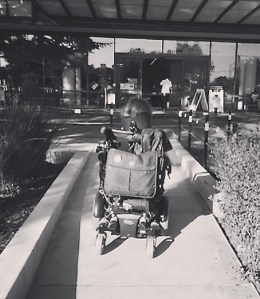
As I’ve discussed frequently before, my custom power wheelchair is a big part of this effort. It’s the most important tool in my life. It’s the object that makes my life— my independence— possible. At the beginning of this year, I began the arduous process of getting a new wheelchair. Medicare requires that many steps be completed before an order can even be processed. Initial Visit With Doctor. Evaluation from Special Physical Therapist. Consult with Wheelchair Provider. Assessment With Doctor.

Each of these steps must be done in a certain order, the documents must be signed and authorized by all parties, and all of it must be done sequentially. Like a really complicated, and really French, pastry recipe. The foofy, pretentious kind. The kind that takes hours to make, you eat in two bites, and leave you hungry afterward.

It’s a fucking nightmare, frankly.

I have a Type A personality. I like to get shit done. This trait has come in handy with my SMA, because such attention-to-detail is why I’m still alive and thriving 35 years after most doctors thought I would be dead.

But, this ‘wheelchair vortex of hell’ doesn’t always reward such preparedness. Because, no matter how on top of things I am, I am still at the mercy of a large medical bureaucracy. The bureaucracy lets unsigned forms sit on desks. The bureaucracy will deny a claim because one date is mistyped on one form. The bureaucracy won’t pick their own nose without a memo telling them which finger to use.

Just a few weeks ago, (but, nearly nine months into the entire process!), Medicare finally authorized my request for my new wheelchair. This was after several paperwork kinks and delays that nearly made me sit in a corner and cry. But, with this authorization, the DME (durable medical equipment) company was then able to place the order with the manufacturers.

You’d think I’d be ecstatic. You’d think I’d be over-the-moon with happiness… you know, just like R. Kelly is in a room of underage girls.

But, I decidedly was not. For I knew that my current wheelchair had to survive until the new chair arrived— which could still take months. And that was the biggest gamble of all.

Because, you see, Medicare would not authorize repairs to an existing wheelchair while a new wheelchair is being ordered. So, I would be majorly SOL if my current wheelchair took a crap in the meantime. Therefore, each bureaucratic delay— each kink that I had experienced in the process— increased the probability of this happening.

And, yesterday, the laws of probability— the laws of mathematics— finally caught up with me. A “RIGHT MOTOR FAULT” error message brought my wheelchair to a halt.

This isn’t the first time this has happened during my wheelchair-using life. In fact, with this wheelchair, alone, I have had to have the motors changed FOUR TIMES. Yes, that’s right. So, when I saw this “RIGHT MOTOR FAULT” error message, I instantly knew that in about a week, my life was seriously going to go down the toilet until I could get new motors installed.

With the arrival of my new wheelchair nowhere in sight, and the necessity of having a functioning wheelchair, I had to do a painful thing. I asked the DME company to order me a new set of motors. I agreed to pay the hefty price. Because, this wheelchair is my basic tool of life, and without it, I can’t function. The DME company understands my pain and kindly agreed to give me a cut rate, but it’s still more money than most people pay for their first shitty car.

To be honest, I actually cried. I sat and cried because I was going to have to find a thousand dollars to fix a device that allows me to live.

It’s demoralizing. And it makes me feel very, very small. In an inaccessible world that’s already stacked against me— a world where I have to be smarter, wittier, and more prepared than everyone else— I still have to scramble for this most basic thing.

But, I don’t have a choice. So, I applied, and received, a disability grant from NMD United to help me pay for some of my replacement motors— and I set up a GoFundMe to cover the remainder of the cost.

The sad thing is, I shouldn’t have to do any of these things. This wheelchair is a medical device. It’s a lifesaving device. I have Medicare. I have a private supplemental insurance plan, too.

I shouldn’t have to peddle to others for something like this. No one with a disability should have to do this— yet, we are forced to do it everyday, in some form or another. It’s so Dickensian. So two-hundred-years-ago.

Yet, nonetheless, here I am, like little Oliver Twist, holding out my small pail—

Please, Sir, I want some more.

oliver

Note: If you are disabled, and have experienced similar problems getting coverage for your specialized wheelchair repairs, please write in & share your story. We must try to speak out when we can. And speak loud. Wheelchairs are more than “durable medical equipment” — they are life-saving and sustaining.