Not a “Great” year, so far.

Standard

Here’s a list of just some of the policy changes that have impacted my life in the last nine months.

  • The massive $1 trillion in Medicaid cuts passed by Congress: in anticipation of these cuts, states have already begun to restrict eligibility for services. Just recently, I had to surrender my financial autonomy & independence just to keep the vital caregiving assistance that allows me to go to the bathroom, take a shower, and do all my daily tasks. As the Medicaid cuts take further effect, I anticipate my caregiving hours will be reduced, and I will have less care and support.
  • I had been scheduled to begin two new groundbreaking treatments for my Spinal Muscular Atrophy in December. These treatments had been in the works for years and the data shows great results. Last week, the federal government delayed the approval and shocked our entire community of doctors, researchers and SMA families. No word on when/if I will be able begin these treatments. (I suspect, given the funding cuts to Medicaid and healthcare, the government doesn’t want to pay for these treatments and decided to kick the can down the road.)
  • The federal government cancelled Rare Disease Day in DC. This worldwide, annual event promotes awareness, support programs, and clinical research into rare disabilities, like mine.
  • This week, the federal government revoked the policies that force airlines to protect disabled passengers in wheelchairs. Corporate airlines lobbied this administration to slash these protections to save themselves money and effort. It worked. It will now be more dangerous for disabled people, like me, to travel. This is a reversal of hard-fought disability rights.
  • For “budgetary” reasons, many states are fighting to erode the federal protections of Section 504 for disabled adults & children in schools. This is an assault on the progress we’ve made to improve disability inclusion. The dismantling of the Department of Education (which enforces these policies) will make this worse.

I’m sad and tired of these systemic efforts to slash vital programs, services and policies that help my disability community.

What has our nation become? What’s next?

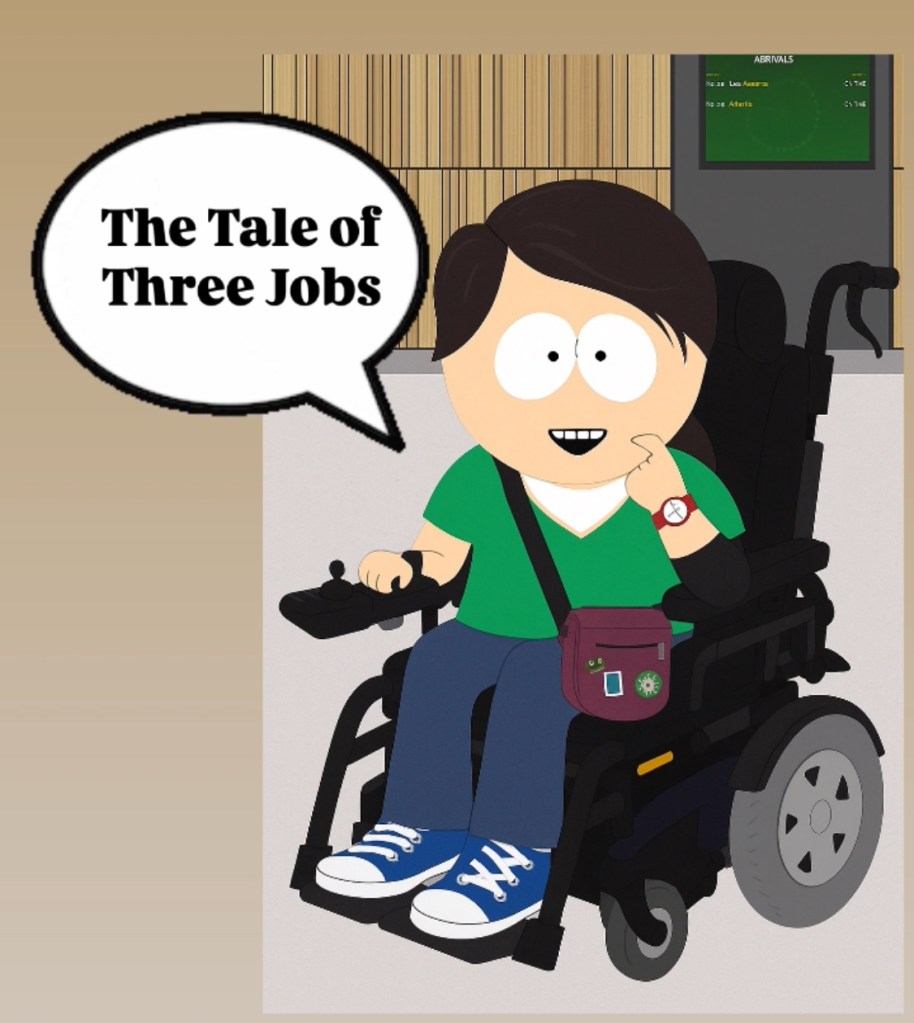
The Tale of Three Jobs

Standard

When you’ve got a significant disability, like I do, you often have three jobs. This makes sense, right? In 2025 America, no one has only one job anymore. Who do they think we are… Boomers?

So here’s a rundown of my jobs. Please note that none of them are with Uber, DoorDash, or the Department of Government Efficiency.

JOB #1

This is my actual job. The thing I do that makes me money (but not too much money). It’s important to note that the amount of money a disabled person can earn is limited. For me, it’s $967 a month. Yes, I know that’s equivalent to a wage from an 1800’s coal mine. It’s a pittance. Especially in our economy where you need a reverse mortgage to buy eggs. But at least I won’t get black lung at 29 and leave behind 7 children to die in a Dickensian hellhole.

I cannot earn more than the prescribed amount. If I do, the federal government will slap me with a hammer and scream: “WTF! YOU ARE NOT DISABLED! STOP FAKING IT, YOU LIAR!” Then, they will take away the meager disability benefits that I receive. For me, that’s also $967 a month.

In case you were under any delusion, being disabled is not a lucrative enterprise. We’re not rolling in cash. We’re not dropping Benjamins at the club like Diddy in the 90’s. We’re lucky if we’ve got extra cash to buy the name-brand “soft” disposable underwear instead of the cheap store brand. After all, peeing your pants in comfort is a luxury for people who aren’t disabled.

JOB #2

This is the administrative/logistical job that a disabled person has to undertake that allows us to… survive? It’s the minutiae of disabled life. It’s the doctor appointments, wheelchair repairs, medication management. It’s the arduous bureaucratic tasks of dealing with insurances and government benefit requirements. It’s the complications of coordinating homecare. And ALL the other assorted stuff that needs to be done. I’d like to point out that Job #2 is the most time-consuming of all my jobs. If I got paid for all the time I spent on it, I’d have PLENTY of money for the fancy paper underpants. The good shit with the soft pink flowers that hug my thighs like a cloud.

JOB #3

This is the most unexpected job of all. This is the extra labor that disabled people like me must do because OTHER people (often medical professionals) don’t know how to do their jobs. This work is unseen, unrecognized, and sometimes… super weird.

There is a widespread belief that healthcare workers are trained in how to handle/assist disabled patients. That their education includes disability awareness and information. Well, I hate to be the bearer of bad news, but that ain’t true. At all. In fact, the most ridiculous things I’ve EVER heard said aloud have come from one of two places. The mouths of healthcare professionals. And the mouth of the dude that lives at the White House.

I once had the following conversation with a cardiologist at an initial consult. (Note: I did not return to see this guy again.)

Me: “Do you have any disabled patients?

Doctor: “Err, yes… so many. You can trust me. Definitely.

Me: “Okay. So, what are your questions for me?

Doctor: “Where do you sleep?

Me: “In a bed.

Doctor: “What do you eat?

Me: “Food.

Doctor: “How did you get here?

Me: “I flew in on a magic carpet.

I wish I could say this was a joke. Or an isolated incident. But stuff like this happens to me ALL the time. I’ve been asked if I can talk… write… read… and do basic thinking. It’s super fun.

At the same time, though, people like me are silently expected to provide lessons and ongoing encouragement to healthcare workers on how to treat us. All because people aren’t trained (or can’t be bothered to learn on their own) how to do so. Often, we must undertake this extra labor in moments of sickness, exhaustion and vulnerability. Because, if we don’t, we won’t receive the care we need. And that can mean the difference between life and death.

Sometimes, though, our efforts are met with resistance. Sometimes healthcare professionals don’t want to admit to their ignorance. They don’t want to ask for help. And it’s these folks that are my favorite targets.

The other day, I had a cardiac ultrasound as part of a routine checkup. When I arrived, the ultrasound technician took a look at me and I saw fear flash in his eyes. I’m well accustomed to this look. I am a boogeyman that ushers stress, despair, and way more work than an ultrasound technician wants at 1:40pm on a Wednesday afternoon.

But, just as quickly as that look arrived, a confident bravado slid down his face. His chin lifted in defiance. Nonetheless, I pushed onward and automatically began to offer him the information he would need to complete the ultrasound. Specifically, I tried telling him that my organs are squished in my body because Spinal Muscular Atrophy causes scoliosis. But, as I was in the middle of warning him that my heart wouldn’t be in the “usual” spot, he waved off my words with a cocky shrug: “Yeah, yeah, yeah. I got it.

I snapped my mouth closed. Inwardly, I gave a little cheer. In that moment, I knew this appointment would be nearly as much fun as the last episode of South Park.

For the next 20 minutes, I lay smirking in the darkened ultrasound room while the technician looked for my heart in all the wrong places. His frown grew larger and larger with each minute that went by. Eventually, he found my heart. (Duh. I’m not a vampire.)

But any satisfaction the technician may have felt in that moment was erased when I said, “I could have helped you find it, but it seemed like you really wanted to do it on your own. It was probably more fun that way? Like a scavenger hunt?

My philosophy is to take joy in the little things. For me, that’s what life is all about. It’s the small things. The little joys. These moments build a full, happy life. And, in that moment, I knew that ultrasound technician wouldn’t forget me. He wouldn’t forget how I made him feel incompetent. He wouldn’t forget how those extra 20 minutes wasted finding my heart meant that he couldn’t watch porn on his phone between patients.

And that made me happy.

So, I guess Job #3 ain’t all bad, right? Some of the perks are worth the frustrations. Too bad they don’t include high-absorbent cotton blends.

Oh, well. A girl can’t have everything.

Collateral Damage

Standard

What I’m going to write here is very important. I ask for your time, patience and understanding.

The programs that support disabled people like me are in peril. Serious peril. Since I suspect this notion will be met with confusion and denial, let me explain why:

At the end of this year, the 2017 Tax Cuts passed during the first Trump administration are set to expire. This legislation offered large tax breaks, mainly to corporations and the top 1% of Americans. This tax cut was primarily funded by increasing the national debt.

Corporations and super wealthy people have really enjoyed these tax cuts. So, they have been lobbying HARD to get these tax cuts quietly renewed this year before they expire. However, to renew these cuts, they first must figure out how to pay for it.

The price tag to renew these cuts? Around $4 trillion. Yes, you read that right. $4,000,000,000,000. That’s twelve zeros. A zero for every day of Christmas. A zero for every Apostle. A zero for every month of the year. A zero for every bulging vein that has developed on my forehead.

Now, here is where you really need to start paying attention. $4 trillion is a ridiculous amount of money. They know this. But the political/financial pressure being put on this new administration and legislative majority to quietly make this tax cut happen is HUGE. It’s bigger than Elon Musk’s ego. It’s the real reason Elon Musk is even in Washington at all.

The House Budget Committee has already begun identifying targets for budget cuts. It would be reasonable to think that every single government agency, program or department would be on the list. But that’s not the case. The number one target on the list?

Medicaid.

The program that serves the most vulnerable of Americans: the poor, the disabled and the elderly.

Sure, finding “fraud” and “wasted spending” in social programs is the explanation provided for Musk’s involvement. But, in reality, fraud and wasted spending in these departments is nominal. it’s incredibly difficult to qualify for these programs and to remain eligible. Further, efficiency and fraud offices already exist because spending money on poor, disabled and elderly Americans is something that the US Government doesn’t really like to do. We’d much rather give a blank check to defense contractors that donate generously to political campaigns.

Instead, they plan to amputate nearly $1 trillion from Medicaid. That’s a quarter of the amount estimated they need to renew the tax breaks for Mr. Musk and his friends.

A funding hemorrhage of that magnitude would be catastrophic for disabled people, like me. The Medicaid programs that provide home and community-based services, medical care, and supplemental nutrition would be thrown to the wolves. We would have to beg for crumbs and scraps in a world where we carry ZERO political clout.

Did you know that people like me can’t run for elected office even if we wanted to? I’d be putting any government assistance I receive in jeopardy. There are strict rules I must follow to qualify for the Medicaid program that helps me get out of bed in the morning and use the toilet. I could lose everything by just trying to be a legislative voice for my disability community.

That is precisely the reason why Medicaid makes such an easy target: we don’t have representation. We don’t have money to buy a seat at the table. We don’t have a corporate lobby. It makes complete sense that they come after us first. If you don’t believe that (or want to believe that), then you might be in denial about how the world works.

This brings me back to where I began. If you voted/support the new administration, I have a request of you. Do you want people like me to be the collateral damage of that vote? Do you want the legacy of this era in history to be the moment when America failed its most vulnerable?

I believe your vote was made with honorable intention. So, are you now willing to hold your elected representatives to account? Are you willing to remind them of their moral and ethical responsibility?

Your support is needed now more than ever. I know you care. But now is the time for action. Please call the offices of your congressperson, and your Senators. Tell them you support Medicaid and want them to vote to protect it– not cut it. And keep calling on a regular basis. It will only take you a moment to do this. While it may not seem like a simple call could make a difference, it does. They listen to their constituents. You have power. Please use it. It could make all the difference.

I’m counting on you.

Call-to-Action

Standard

Dear Readers & Supporters:

The results of this election will have far-reaching impacts on the programs and services that my disability community relies upon. The heavy tax cuts prioritized by the incoming presidential administration and Congress will come with a price. Something will pay. And, if history serves, the programs that support disabled adults and disabled children are the easiest and most-likely target for these cuts. The most vulnerable always suffer in times like these. Disabled people like me are deeply frightened about what will happen in the coming years. For us, it’s about survival— and living independently in our communities and having access to support services. Others have the privilege to vote on the price of eggs, which candidate is more “Christian,” which candidate allows them to buy 7 guns they don’t need, which candidate they think “loves America more,” or which candidate will protect them from supposed boogeymen that eat cats & dogs. But, we disabled people have to worry about a budget cut that means we only get to go to the bathroom twice a day, instead of three or four times. Or, figuring out what to do when the program that provides the meals that fit our specific nutritional needs is slashed to give a tax cut to those that don’t need it.

Disabled children and disabled adults must not be sacrificed in political storms.

To that end, I have attached a copy of the note that I will be sending to all my elected representatives in the coming days/weeks/months. If you want to be part of this advocacy effort, feel free to borrow from it for your own outreach purposes. Your support is appreciated and needed.


Here is a link to find your specific elected officials: https://www.usa.gov/elected-officials


LETTER SAMPLE

As your constituent, I am writing to affirm your commitment to support and defend the rights and care of disabled Americans. I was born with a severe neuromuscular disability called Spinal Muscular Atrophy. The heavy tax cuts prioritized by the incoming presidential administration and legislatures WILL come with a price. If history serves, the programs that support disabled adults and disabled children are the easiest and most-likely target for these cuts. The most vulnerable always suffer in times like these, but you have a duty to look after our interests. The disability community must not fall victim, as they have in the past, to political whims and selfish agendas that often leave us behind.

I ask that you pledge to safeguard priority funding for Medicare, Medicaid, in-home supportive services, public education, DDS regional centers, and supplemental nutrition programs (including medically-tailored meals). These services are vital to our disability community and we are deeply frightened about what will happen in the coming years. Our lives are in your hands. We have a right to live safely and independently in our communities.

I hope you take these words to heart. We are a large and diverse community of disabled adults, disabled children, loving families, and supportive allies. We are ready to make our voices heard.

Please don’t let us down.

Thank you.

Get your copy!

Standard

Have you ordered your copy of my award-winning book, Murder at the Boardinghouse, yet? 📚 There are currently EIGHT ways you can get it:

1. Order directly from me (and get your copy signed!): https://subscribepage.io/eTMJkx

2. Buy from the Center for Basque Studies Online Bookstore.

3. Pick up a copy from Patterson Family Pharmacy🏥

4. Buy one at the famous JT Basque Bar & Dining Room in Gardnerville! 🐑🍷

5. Order it from Barbot Etchepare Basque Imports! 💚❤️

6. Grab it at the historic The Star Hotel in Elko! 🍽️

7. Snag one at Blackrock Wine Co. in Reno! 🍷🧀

8. Lastly, you can find it on Amazon (proceeds from Amazon sales benefit the Center for Basque Studies). 💰

Masks, please.

Standard

This blog post will be a little more serious than my usual ones. There will be fewer cuss words, fewer jokes about politicians, and fewer references to pumpkin spice products. But, please keep reading, anyway.

A few weeks ago, I was invited to speak at a conference about my disability— Spinal Muscular Atrophy. This conference is a way for medical professionals to learn the newest research and collaborative ways to improve patient care. As a person with SMA, they wanted me to offer my perspective and feedback to the attendees.

I quickly agreed. Highlighting the lived experiences of disabled people is something that is often missing from events like these. Nothing annoys me more than having nondisabled people talking about how best to “care” for us without any effort to elevate our disabled voices. So, any chance I get to promote disability awareness– I am definitely going to take it.

So, I was all-in on speaking at the conference. After all, the knowledge that I have as a person that has lived with SMA my entire life is just as valuable (if not more so) than a doctor with four framed degrees on their office wall.

I started planning what I would say. What to wear. What topics seemed important to me. How I needed to make sure not to use any four letter words– which I tend to do, even when I don’t mean to. (I’m working on this. Really.)

However, after I happily agreed to participate, I found out something that changed everything. Masks were voluntary at the conference— they were not required. And the only way I found this out was that I had to directly ask an organizer about this safety protocol. If I had not asked, I would have shown up to the event unaware of this.

So, in summary:

A medical conference about Spinal Muscular Atrophy (one of the most complex, deadly genetic diseases in existence) seemed to be okay with not making masks a requirement to attend their event.

The reason for this decision? The conference organizers didn’t want to “impose additional requirements” on attendees. (The targeted demographic for the conference being medical professionals— who are nondisabled).

Yet, it didn’t seem to register that they were now hosting an SMA conference where an actual SMA person doesn’t feel comfortable attending.

Now, I know I’m not in PR, but this doesn’t have good “optics.”

In addition, many of these medical professionals will interact with high-risk SMA folks regularly. They don’t think a masked event is a good idea? I’d think the only thing they’d want to bring home from the conference is a free T-shirt and a stale poppyseed muffin from the breakfast bar— not an infectious disease.

To be perfectly honest, when I learned this, my stomach dropped. I felt nauseated. I felt tears prickle the corner of my eye. (It’s ableism at its most basic— prioritizing the wants/whims of the nondisabled to the disabled’s exclusion.)

Yet, a part of me was not surprised given how the world is trying so hard to return to normality. But, for those with SMA (and other disabilities) we’re endangered when society tries to act like the last 2.5 years didn’t happen.

Disabled people, especially disabled people of color, have had the highest mortality rates for COVID-19— and the lowest access to health care. This pandemic has been real to us in a way that it hasn’t been for other people.

The trauma of this continues for us each and every day. Yet, while society is now trying to “live with the virus,” disabled people are the ones more likely to die from it.

As a result, within the disability community, masking is seen as a form of accessibility. Like elevators, ramps, ASL interpreters, closed-captioning and large-print. Masking (along with testing and vaccines, of course) allows high-risk people to participate in society more safely, securely and fully. It is a way to say, “I care about you. I see you. I want you here.

Therefore, despite my initial enthusiasm, I won’t be attending this SMA conference. I am disappointed and sad. Disability can be isolating, and it cuts a little deeper when society displays such obliviousness.

So, I am left with this final suggestion: if you are planning a public event, please consider the disabled when you do so. By going beyond the basic policies of your city/school/company, you can ensure your event is more accessible and inclusive. (After all, those policies were made for political/economic reasons that suit the nondisabled masses. Not people like us.)

Don’t forget: the disabled will never be able to take a seat at the table unless we feel safe to do so.

It’s up to you to help make that happen.

UPDATE: Upon reading this blog post, conference organizers changed the policy to make masks mandatory. As a result, I decided to participate in the event. While I am happy they reconsidered, I’m also disheartened by the lengths that disabled people like me have to go simply to have our needs met. This extra labor is exhausting— especially when many of these accommodations should already be in place. —E.

Death by Bureaucracy

Standard

#DisabledLife is filled with unexpected surprises. Sometimes, it’s having a caregiver call out, leaving you scrambling to find someone to come get you out of bed before your bladder explodes. Sometimes it’s getting into your wheelchair, desperate for coffee, only to discover that the motors have died. Mind you, this is just 18 months after you spent $1,000 to replace those same motors. Good luck getting insurance to pay for it… those miserly wankers only dispense wheelchair repair money in tiny allotments— like it’s radioactive uranium. 

#DisabledLife is also all the time you burn navigating the minutia of a society not designed for people like you. Inaccessible places. Healthcare bureaucracy. People that won’t wear masks. But, if that wasn’t enough, #DisabledLife is also spending hours trying to get medical professionals to believe that you know more about your own needs than they do. (Heaven forbid!)

This weekend, I had another one of these #DisabledLife surprises. In my mailbox, there was a packet with one of the most dreaded return marks in the corner:

SOCIAL SECURITY ADMINISTRATION

When I saw it, I knew that nothing fun would be inside. There would be no Target gift cards, or 50% off coupons for pumpkin spice candles. There would be no sweet messages with heart emojis or stickers that smell like root beer. Instantly, I knew that no matter how good my day had been going up to that point, that the rest of my joy (and patience) was going to be drained by the contents of that envelope— like a damn black hole.

“Fuck.”

Yes, I actually said this aloud.

Then, I stared at the envelope for a few moments, debating when/how to open it. I eyed it suspiciously, like a bomb squad specialist defusing an explosive. When I couldn’t take the anxiety anymore, I grabbed my homemade letter opener (with a long handle designed for my weak, skinny hands), and sliced it open.

I read the top of the page:

“The Social Security Administration must regularly review the cases of people getting disability benefits to make sure they are still disabled under our rules. It is time for us to review this case. Enclosed is a Disability Update Report for you to answer to update us about your health and medical conditions, and any recent work activity… Please complete the report, sign it and send it to us in the enclosed envelope within 30 days…”

In case this jargon is confusing, let me translate: Social Security has given me 30 days to prove that my permanent, genetic disability hasn’t magically disappeared… like classified documents do at Mar-a-Lago.

I grumbled. And cussed some more. Then, I changed my weekend plans from “Binge Abbott Elementary on Hulu” to “Fill Out Useless Paperwork.”

My irritation was massive. It took all my willpower not to set the packet on fire. (Truly.) Yet, I managed to complete the forms. For the sake of my own sanity, though, I added the following letter for good measure.

Think they will reply?…

October 8, 2022

SOCIAL SECURITY ADMINISTRATION, P.O. BOX 4550, WILKES BARRE, PA 18767-4550

SENT VIA UNITED STATES MAIL

Dear Person Working At The Social Security Administration:

Hello. First, I’m sorry that you work at Social Security opening mail and reading letters just like this one. Everyday. Even after you’ve been sick with the “flu” — or, as is more likely, just hungover from too many margaritas.

Second, I’d like to introduce myself. My name is Elizabette. I live in California with a cat named Charley that likes to steal my breakfast. I was diagnosed with Spinal Muscular Atrophy, a genetic neuromuscular disability, at the University of California, San Francisco, just before my 2nd birthday. I started using a wheelchair at the age of four, when most kids are just learning how to pick their nose. My disability is progressive, so I transitioned to a power wheelchair at the age of seven.

Third, I’d like to assure everyone at the Social Security Administration that, yes, I’m still disabled. My genetic disability can’t be cured by clicking my heels together three times. In fact, I couldn’t even click my heels together if you asked me. Because, yes, I’m THAT disabled.

I need help with all my daily needs— like getting out of bed, showering, getting into my wheelchair, and cooking meth in my kitchen.

Anyway, here are a few more facts that might help you determine my disabledness. (Yes, I just made up that word. Feel free to use it, if you want.)

— I’m unable to drive, so I must hitchhike everywhere like a 1970s hippie just before they were murdered by the Zodiac Killer.

(Just kidding. Folks drive me around in an adapted minivan. You know, the kind of car that hauls around eight-year-olds and smells of stale Happy Meals.)

— I’m a patient of the Stanford Neuromuscular Clinic. I am followed by their team of neurologists, pulmonologists, physical therapists, respiratory therapists, nutritionists, butchers, bakers, and candlestick makers. My last checkup was on March 15, 2022. My next checkup is just a few days away.

— I’m attaching a copy of my health record from Stanford, just in case you don’t believe how damned disabled I actually am.

— I work from home a few hours a week as a bookkeeper. This part-time job gives me the flexibility to rest when necessary, and to tailor my work-schedule to my physical and medical needs. I can’t work a full-time job, or work away from home.

— My job pays me $600 a month. You folks at Social Security only give me $596 a month because you think I live in an alternative timeline where everything costs the same as it did in 1958. I use all my money to pay my caregivers. Every. Single. Dime. And it’s NOWHERE near enough to cover the total cost. This is why I sell my body on Craigslist.

— My lung capacity is 42%. Given my respiratory weakness, I am at-risk of severe complications from most illnesses. So, I avoid crowded, public spaces. This is a bummer, yes. But as most people kinda suck, I actually don’t miss this as much as you’d think.

— Oh, and I am unable to wipe my own butt. So someone else has to do it for me. Further, I poop twice a day. I know you didn’t ask this on the form. But, as Social Security seems to want to verify EVERYTHING about me, you might as well know this, too, right?

I guess that’s it for now. Let me know if you need me to provide anything else— like my firstborn child.

Most sincerely,

Elizabette

I know it’s been awhile

Standard

(appeared in today’s Patterson Irrigator HERE)

Hello fellow Pattersonites! It’s me. I know it’s been months since I’ve written. Time got away from me. It really did. Seems like just yesterday we were washing our groceries with dish soap and feeling grateful to find 1-ply toilet paper at the store. We didn’t care that our butts were chafed, we were happy to be alive.

I apologize for the delay in checking in, of course, but I thought I should touch base so you know that I’m not dead. Also, I wanted to let you know that I haven’t done anything crazy since last I wrote, either. For example:

#1. I haven’t joined a cult.

#2. I haven’t wasted twenty million dollars to go to space with Elon Musk.

#3. And I definitely haven’t joined an online multi-level marketing scheme to sell organic lip balm to every person I’ve known since 1997.

(Come to think of it, both #2 and #3 are also cults.)

Anyway, I hope you’ve been staying well and safe— and that you aren’t dehydrated from sobbing at the gas pump. So, make sure you drink lots of water and refrain from other activities that are bad for your health, too— like watching TikTok videos or being within six feet of Aaron Rodgers.

A lot has happened since last I wrote— on the local level, on the global level and on the personal level. But I can go no further without remarking on a sad local event. The passing of Ron Swift.

Publisher emeritus, quip master, and all-around stupendous fellow, Patterson will never again know a man as dedicated as Mr. Swift. We were lucky that Ron made this town his home all those years ago. For while Ron knew the things that needed doing, Ron also DID the things that needed doing. And it was done with a wry smile, self-deprecating wit— and little fanfare.

We could all learn something from that.

Seventeen years ago, Ron welcomed me to the Patterson Irrigator columnist family with open arms and was always there if I needed him. I appreciated that very much. He was Patterson’s very own Yoda, offering valuable perspective in a unique way that was always genuine and always unpretentious.

What a guy, Ron was. Missed, he will be.

On the global front, the last two years have been seismic. And, no, I’m not just talking about when Will Smith slapped Chris Rock. It’s been crazytown all over the place. For two years. Remember when a bunch of people attacked the US Capitol like zombies from The Walking Dead? Or when Prince Harry decided royal life was total crap? Or when Tom Brady retired from the NFL only to unretire himself a few weeks later?

It’s important to note that during much of this time many of us did not wear real shoes. Only socks or slippers with treads on the bottom for when we went to the grocery store. Or when we walked the 10 feet to our front door to grab the pile of Amazon packages sitting there. Sadly, we went so long without wearing real shoes that we can no longer fit them on our stumpy feet. But, when we go online to buy new (bigger) shoes, we now discover that shoes are 259% more expensive than the last time we bought them.

Yet, truthfully, it hasn’t all been bad. We did learn how to bake banana bread and what it felt like to spend 168 hours a week with our own children. So, there is that.

I do have to say, though, that some things that happened since my last column did come as a surprise to me. For example, I did not have “Putin Goes Ballistic” on my 2022 bingo card. Sure, I’ve made a lot of jokes about Putin in the past. About his shortness, his love of Botox, and the way his beady eyes look like death lasers. But I didn’t think he’d start a reenactment of the year 1939. Maybe I was naive, but you’d think he would have known that it was a bad idea. After all, everyone hates a bully. Everyone. It’s baked into our human genome. We hate bullies just as much as we love chubby babies, ranch dressing and Labradoodles. It’s even in the Bible. (Just ask Goliath.)

On a personal note, since my last column, two big events have happened in my life. First, I got an orange kitten. His name is Charley and he loves cheddar cheese, chasing tin foil balls, and taking naps on my wheelchair— mostly while I’m sitting in it. We’ve acclimated to life together pretty well, especially considering he tries to steal my breakfast two or three times a week. I’m sure I’ll share more about Charley in the coming days. After all, it’s hard for me to write about much else since he spends most of his day sitting on top of me. So, stay tuned.

The other big news? I turned 40. This may not sound like a big deal to most, but to me, it really was. After all, for most of my life, I didn’t know if I would live to see the age of 40 because most born with my disability do not.

As a kid, reaching 40 years old seemed like a mythical accomplishment. Something that was theoretically possible, but not likely to happen— like growing up to marry Indiana Jones or becoming best friends with DJ Tanner. While cool possibilities, it definitely was not in the cards for me.

In all honesty, the arrival of the COVID pandemic did not bode well for my chances to reach this milestone. I watched disabled and high-risk folks here, and around the world, lose battles with the virus. Yet, at the same time, I saw many doubt the risks. I heard jokes about masks, vaccines and other protective measures. Weirdly, I can understand this. After all, it’s easier to believe you’re immune from it all when you don’t look like me. It’s easier to push it all aside when you think you’re not one of those “pre-conditioned people.”

Coming into my 40th birthday during this pandemic was a surreal experience. For two years, each day has been difficult— for ALL of us. Yet, personally, I have keenly felt that each day has been a gift, too. Even though we still have a long way to go, each day I have survived has been a small victory.

Thus, when the clock ticked to midnight on my 40th birthday, I stared out into the darkness of my bedroom—contemplating how far I had come. And, then, I whispered:

“Watch out, Indiana Jones… I’m coming for you.”

Ableism: The “-ism” No One Talks About

Standard

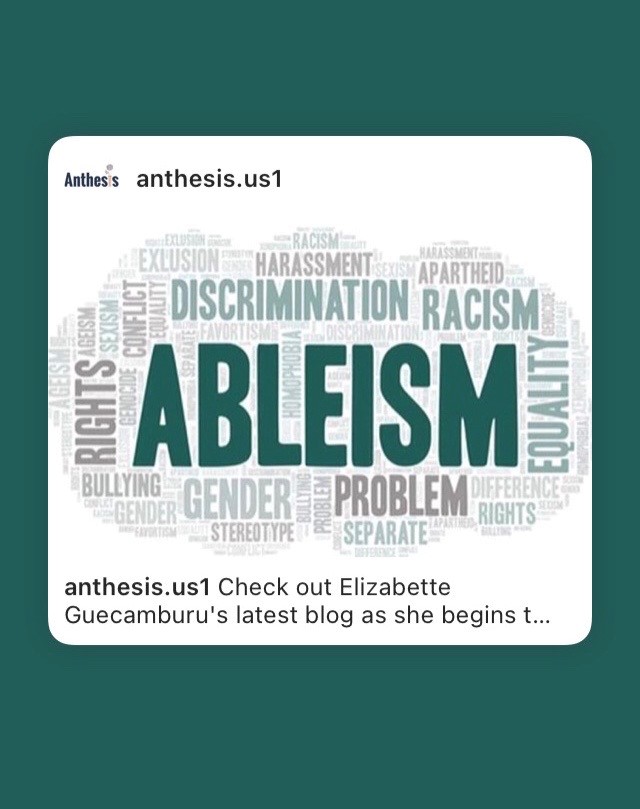
(repost from my article on the Anthesis website)

When you think about discrimination, what comes to mind? Take a moment to ponder it. In your mind’s eye, who do you picture being discriminated against? How does this discrimination manifest? Where does it happen? And, lastly, why does it happen?

I ask these questions because we all have preconceived notions about discrimination. We may think about racism. Or sexism. Or homophobia. Or religious persecution. Our shared history has taught us to recognize some, more blatant, forms of these discriminations— but, sadly, we have a long way to go to identify and rectify the consequences that have resulted from them.

But there is one “-ism” that very few people know about. In fact, if they’ve heard the word, they likely don’t even know what it means. Yet, it’s an “-ism” they’ve most likely witnessed, and, I daresay, even directly enabled at some point in their lives.

I’m talking about ableism. The textbook definition, itself, is even vague— as if the person writing for Oxford Dictionary wasn’t quite sure what it is, either:

a·ble·ism, noun

/ˈābəˌlizəm/ 

discrimination in favor of able-bodied people.

No offense to the Oxford folks, but this definition isn’t helpful. Yet, oddly, the sparseness— the vagueness of it— and the fact that the definition doesn’t even mention the target of the discrimination… well, that says a LOT about how veiled and insidious ableism can be.

So, let’s expand this definition a little. Ableism is discrimination against people with disabilities based on the deep-seeded societal belief that they are inferior to the nondisabled. It is rooted in the long-held assumption that disabled people require ‘fixing,” and a notion that they are incapable of being full, independent members of society. Like other “-isms,” ableism classifies an entire group of people as ‘less than,’ and perpetuates harmful stereotypes and misconceptions of people with disabilities.

Ableism can occur in overt, obvious ways— through things like abuse, direct exclusion and denial of access. But, it’s the more subtle forms of ableism that can often be the most harmful to those with disabilities.

I am disabled. I’ve written about some of my life experiences here in this blog. Ableism is something I’ve quietly experienced my entire life— but during my younger years, I didn’t have the language or the ability to put it into words. Or, to really examine what I knew in my bones to be true:

Society saw me differently than others. I was measured to a different standard. Less was expected of me, yet I had to achieve FAR more to be taken seriously. To be heard. To be valued. I had to minimize my disability and shrink it down into the teeniest box imaginable. Even if I knew I couldn’t manage it. Even if I knew it wasn’t sustainable for me in the long run. 

You see, ableism demands these things of the disabled. Because being less disabled means that society values you more. You will have more access to education, employment, and economic opportunity. You will be listened to— and you will have more access to the healthcare and community services you may need.

Society perpetuates these values day after day. Ableism is baked right into the foundation of it— like walnuts in a loaf of banana bread. It’s the reason why the disabled are always one of the first groups to suffer during times of upheaval, like the COVID-19 pandemic. Ableism teaches us that the disabled are more expendable than the able-bodied. We see those values playing out right now in real-time.

There are undercurrents of ableism in the protests to masking, vaccine requirements and other public health measures. These protocols serve to protect the disabled and vulnerable, but as many of these protesters see themselves as “healthy,” they don’t see why they must do these things. They subconsciously believe their rights and their value exceeds that of others. Why do they think this? It’s not simply a matter of “selfishness” or a lack of “morality” (that’s too simplistic, and also, untrue). You see, it’s ableism that justifies this position in their minds. Ableism is what subtly reinforces the idea that they are superior to the ones they are being asked to protect.

This dark side of ableism can be very dangerous for the disabled. For that reason, it’s the one that many people don’t like to talk about. It makes folks uncomfortable. After all, society is invested in the narrative that it “takes care” of the vulnerable among us. We want to think this is true. And, while we do great things to care for others (we really do!), we still have a long way to go to achieve equity for the disabled. To achieve full personhood for the disabled.

No discussion of ableism, however, can be complete without acknowledging the added barriers and discriminations that disabled people of color experience. All the challenges of getting access, accommodation and resources are exponentially compounded for the disabled in communities of color. This is why disabled people of color are in the highest mortality group for COVID-19. Ableism and racism can combine in ways that can be deadly. We must not be afraid to acknowledge this and address it. No work to combat ableism can be fruitful without efforts to tackle these added racial disparities.

The disability community needs allies in these efforts. Our voices, alone, won’t make things change. Do you want to do your part? If so, I recommend that you learn more about ableism— and all the ways it can show up in our daily lives. My explanation above is rudimentary, so there is much more to learn. Here are a few links to check out:

Death by a Thousand Words: COVID-19 and the Pandemic of Ableist Media by Imani Barbarin

Disabling Ableism TEDtalk

What is Ableism?

This brief list is just an entry point. After all, the disability community’s experience with ableism is as diverse as the community itself. Yet, there are commonalities that bind us together. So, your first step is learning to recognize ableism when you see it— because, trust me, you will see it.

And once you do see it, you will have no excuse not to do anything about it. The power to make change will then rest with you.

Let’s get started, shall we?

New Gig

Standard

Hello, all! It’s me. I know it’s been months since I’ve written. I’ll fill you in on the reasons for that later (nothing bad!), but I just wanted to touch base to let you know that I’m not dead.

Also, please be assured that I haven’t done anything crazy in the interim, either.

For example:

#1. I haven’t joined a cult.

#2. I haven’t squandered $20M to go to space with Elon Musk.

#3. And I definitely haven’t joined a multi-level marketing scheme to sell organic lip balm to every single person I’ve known since 1997.

(Come to think of it, both #2 and #3 are also cults.)

Anyway, I just wanted to give you a short update on my latest project. A few months ago, Anthesis, an organization that serves developmentally disabled adults, asked me to come aboard as a contributing writer for their blog. It’s been a fun collaboration and I’m fully supportive of every attempt a company/organization makes to amplify disabled voices and perspectives.

You can check out my recent work for Anthesis by clicking on this link HERE.

More from me soon!!

XOXO,

Elizabette