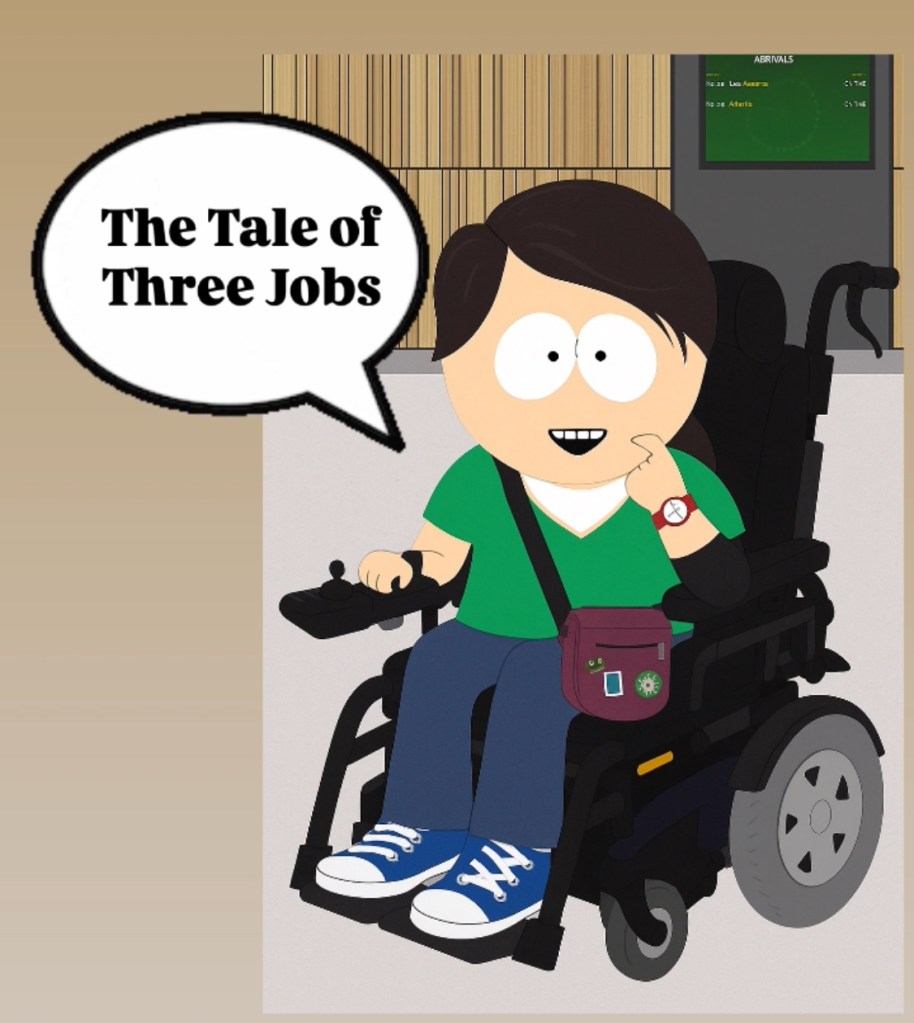
When you’ve got a significant disability, like I do, you often have three jobs. This makes sense, right? In 2025 America, no one has only one job anymore. Who do they think we are… Boomers?
So here’s a rundown of my jobs. Please note that none of them are with Uber, DoorDash, or the Department of Government Efficiency.
JOB #1
This is my actual job. The thing I do that makes me money (but not too much money). It’s important to note that the amount of money a disabled person can earn is limited. For me, it’s $967 a month. Yes, I know that’s equivalent to a wage from an 1800’s coal mine. It’s a pittance. Especially in our economy where you need a reverse mortgage to buy eggs. But at least I won’t get black lung at 29 and leave behind 7 children to die in a Dickensian hellhole.
I cannot earn more than the prescribed amount. If I do, the federal government will slap me with a hammer and scream: “WTF! YOU ARE NOT DISABLED! STOP FAKING IT, YOU LIAR!” Then, they will take away the meager disability benefits that I receive. For me, that’s also $967 a month.
In case you were under any delusion, being disabled is not a lucrative enterprise. We’re not rolling in cash. We’re not dropping Benjamins at the club like Diddy in the 90’s. We’re lucky if we’ve got extra cash to buy the name-brand “soft” disposable underwear instead of the cheap store brand. After all, peeing your pants in comfort is a luxury for people who aren’t disabled.
JOB #2
This is the administrative/logistical job that a disabled person has to undertake that allows us to… survive? It’s the minutiae of disabled life. It’s the doctor appointments, wheelchair repairs, medication management. It’s the arduous bureaucratic tasks of dealing with insurances and government benefit requirements. It’s the complications of coordinating homecare. And ALL the other assorted stuff that needs to be done. I’d like to point out that Job #2 is the most time-consuming of all my jobs. If I got paid for all the time I spent on it, I’d have PLENTY of money for the fancy paper underpants. The good shit with the soft pink flowers that hug my thighs like a cloud.
JOB #3
This is the most unexpected job of all. This is the extra labor that disabled people like me must do because OTHER people (often medical professionals) don’t know how to do their jobs. This work is unseen, unrecognized, and sometimes… super weird.
There is a widespread belief that healthcare workers are trained in how to handle/assist disabled patients. That their education includes disability awareness and information. Well, I hate to be the bearer of bad news, but that ain’t true. At all. In fact, the most ridiculous things I’ve EVER heard said aloud have come from one of two places. The mouths of healthcare professionals. And the mouth of the dude that lives at the White House.
I once had the following conversation with a cardiologist at an initial consult. (Note: I did not return to see this guy again.)
Me: “Do you have any disabled patients?”
Doctor: “Err, yes… so many. You can trust me. Definitely.”
Me: “Okay. So, what are your questions for me?”
Doctor: “Where do you sleep?”
Me: “In a bed.”
Doctor: “What do you eat?”
Me: “Food.”
Doctor: “How did you get here?”
Me: “I flew in on a magic carpet.”
I wish I could say this was a joke. Or an isolated incident. But stuff like this happens to me ALL the time. I’ve been asked if I can talk… write… read… and do basic thinking. It’s super fun.
At the same time, though, people like me are silently expected to provide lessons and ongoing encouragement to healthcare workers on how to treat us. All because people aren’t trained (or can’t be bothered to learn on their own) how to do so. Often, we must undertake this extra labor in moments of sickness, exhaustion and vulnerability. Because, if we don’t, we won’t receive the care we need. And that can mean the difference between life and death.
Sometimes, though, our efforts are met with resistance. Sometimes healthcare professionals don’t want to admit to their ignorance. They don’t want to ask for help. And it’s these folks that are my favorite targets.
The other day, I had a cardiac ultrasound as part of a routine checkup. When I arrived, the ultrasound technician took a look at me and I saw fear flash in his eyes. I’m well accustomed to this look. I am a boogeyman that ushers stress, despair, and way more work than an ultrasound technician wants at 1:40pm on a Wednesday afternoon.
But, just as quickly as that look arrived, a confident bravado slid down his face. His chin lifted in defiance. Nonetheless, I pushed onward and automatically began to offer him the information he would need to complete the ultrasound. Specifically, I tried telling him that my organs are squished in my body because Spinal Muscular Atrophy causes scoliosis. But, as I was in the middle of warning him that my heart wouldn’t be in the “usual” spot, he waved off my words with a cocky shrug: “Yeah, yeah, yeah. I got it.”
I snapped my mouth closed. Inwardly, I gave a little cheer. In that moment, I knew this appointment would be nearly as much fun as the last episode of South Park.
For the next 20 minutes, I lay smirking in the darkened ultrasound room while the technician looked for my heart in all the wrong places. His frown grew larger and larger with each minute that went by. Eventually, he found my heart. (Duh. I’m not a vampire.)
But any satisfaction the technician may have felt in that moment was erased when I said, “I could have helped you find it, but it seemed like you really wanted to do it on your own. It was probably more fun that way? Like a scavenger hunt?”
My philosophy is to take joy in the little things. For me, that’s what life is all about. It’s the small things. The little joys. These moments build a full, happy life. And, in that moment, I knew that ultrasound technician wouldn’t forget me. He wouldn’t forget how I made him feel incompetent. He wouldn’t forget how those extra 20 minutes wasted finding my heart meant that he couldn’t watch porn on his phone between patients.
And that made me happy.
So, I guess Job #3 ain’t all bad, right? Some of the perks are worth the frustrations. Too bad they don’t include high-absorbent cotton blends.
Oh, well. A girl can’t have everything.

![CE8727C8-8FF6-45B6-8FA5-24181A4A7B92[2598]](https://elizabetteunplugged.com/wp-content/uploads/2020/03/ce8727c8-8ff6-45b6-8fa5-24181a4a7b922598.jpg)
 elizabette... unplugged